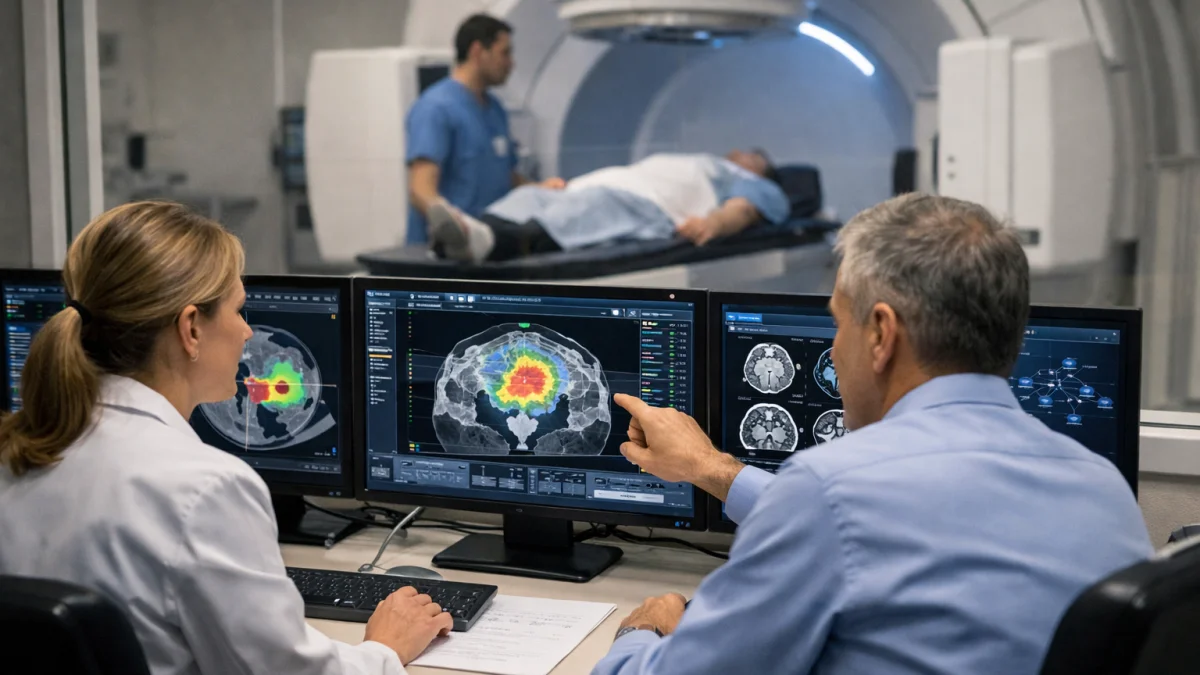


CHICAGO — The U.S. Food and Drug Administration has cleared an updated artificial intelligence-powered software platform designed to assist radiation oncology teams with cancer treatment planning, marking another regulatory approval for AI-enabled tools in clinical care, according to the manufacturer and regulatory filings.
GE HealthCare announced earlier this month that the FDA granted 510(k) clearance for MIM Contour ProtégéAI+ 2.0, an updated version of its auto-contouring software used in radiation therapy planning. The software is designed to help clinicians identify and outline anatomical structures and treatment areas on medical images, a process that is considered a critical step in preparing radiation treatments for cancer patients.


The updated platform introduces new artificial intelligence models, including a magnetic resonance imaging (MRI) brain model and an enhanced computed tomography (CT) male pelvis model. GE HealthCare said the additions are intended to expand the software’s clinical applications across multiple anatomical regions.
According to the company, the software automatically processes CT and MRI scans with limited user interaction and exports results directly into treatment-planning systems used by radiation oncology departments. GE HealthCare said the underlying AI models were developed and validated using multi-institutional datasets.
“Our technology is designed with the realities of our customers in mind,” J. Anders, general manager of MIM at GE HealthCare, said in a statement released following the clearance. “By automating one of the most time-intensive steps in radiation therapy planning, MIM Contour ProtégéAI+ 2.0 can help reduce treatment planning time.”
The FDA clearance also includes a Predetermined Change Control Plan, a regulatory framework that allows future updates and enhancements to be introduced under specified conditions without requiring a separate regulatory submission for each modification. GE HealthCare said the approach could facilitate expansion into additional anatomical regions and imaging modalities over time.
Radiation therapy remains a major component of cancer treatment worldwide. GE HealthCare cited industry and public-health data indicating that radiation therapy is used in a substantial share of cancer cases and that demand for more efficient treatment-planning tools continues to grow.
The clearance comes as the FDA continues to evaluate an increasing number of AI-enabled medical devices. Regulatory records show that several AI-based radiation therapy imaging and contouring tools have received FDA clearance in recent years under the agency’s medical device review process.
As of Monday, GE HealthCare said the newly cleared software was available for integration within its radiation oncology technology portfolio. The company has not disclosed adoption figures, and details regarding deployment schedules at individual treatment centers remain unclear.