

Greece is intensifying mosquito surveillance and control measures after a sharp early-season rise in West Nile virus infections, with health authorities reporting 21 locally acquired cases by July 22, including 14 diagnosed in a single week. The speed of the increase, combined with the unusually high share of patients developing neurological complications, has made the outbreak an important test of Greece’s seasonal disease surveillance and vector-control system.
The immediate significance is less the absolute number of infections than the pattern. Twenty of the 21 patients reported by Greece’s National Public Health Organization, EODY, had central nervous system involvement, including encephalitis, meningitis or acute flaccid paralysis, while 13 were hospitalized. No deaths had been recorded at that point. The World Health Organization’s European office described Greece as having the steepest recent rise among affected countries, while urging stronger mosquito surveillance and public awareness across Europe.


The concentration of cases also helps explain the response. Most infections were reported in Attica, including Spata-Artemida, Markopoulo Mesogaias, Pallini and Agia Paraskevi, with additional cases in Athens-area municipalities and in Larissa and Palamas. EODY has identified several nearby municipalities as high-risk areas even where human infections had not yet been reported, using epidemiological, geographical and proximity criteria. That approach reflects the difficulty of containing a mosquito-borne virus solely by responding after human cases appear.
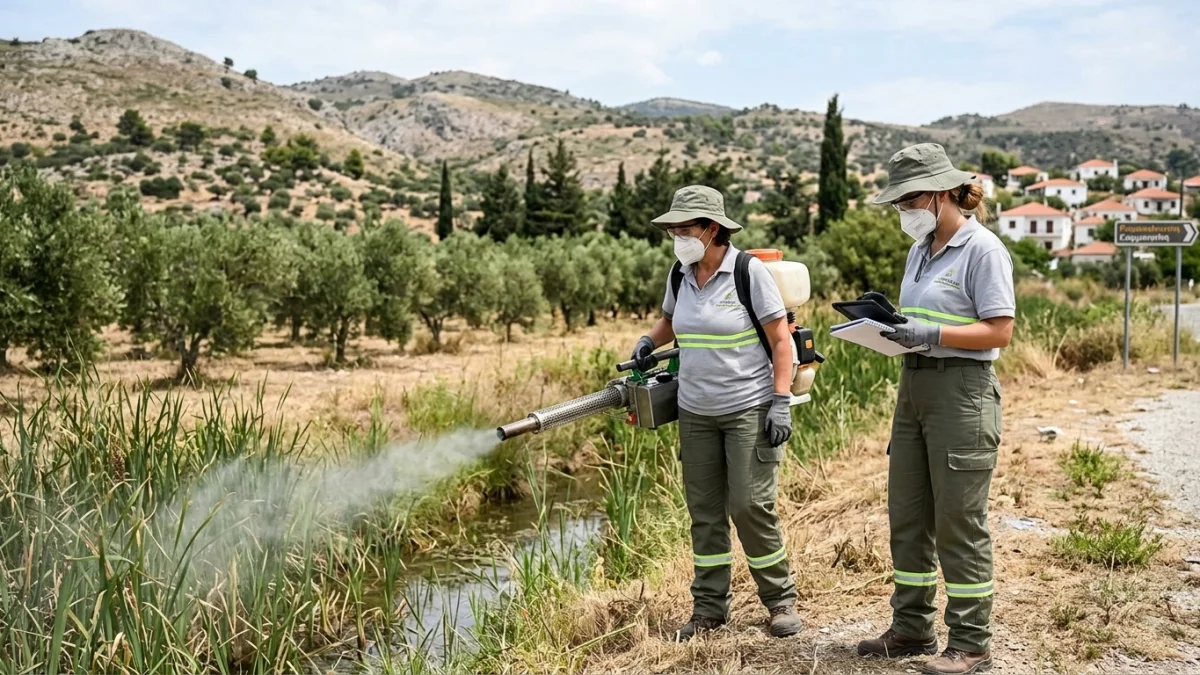
Greece’s control strategy is therefore built around surveillance as well as intervention. EODY says local authorities are institutionally responsible for mosquito-management programmes, while national health authorities conduct enhanced epidemiological surveillance, investigate cases and assess risk. The national response framework allows additional measures in affected and high-risk areas, including mosquito-control operations and, where appropriate, precautions related to blood safety.
That system matters because West Nile virus cannot be eliminated simply by treating infected people. The virus normally circulates between mosquitoes and birds, with humans becoming incidental hosts through the bite of an infected mosquito. EODY recommends reducing exposure through approved repellents, window screens, mosquito nets, air conditioning or fans and appropriate clothing, while also eliminating standing water that can provide breeding sites.
The Greek authorities also face a structural challenge: West Nile virus is no longer an unusual event in the country. EODY records human infections in Greece in most transmission periods since 2010 and says virus circulation has been detected across all regions. Between 2010 and 2025, Greece recorded 2,184 cases, with about 71% involving central nervous system disease and about 14% resulting in death, predominantly among older people or those with chronic health problems. These historical figures help put the current outbreak into perspective while also showing why early detection is important.
The wider European picture reinforces that concern without suggesting that Greece faces an isolated epidemic. By July 22, the European Centre for Disease Prevention and Control had recorded 81 locally acquired cases across six European countries, including 21 in Greece. Italy had the largest number and the broadest geographic distribution, while locally acquired infections were also reported in Romania, North Macedonia, Spain and France.
Weather and environmental conditions are an important part of the surveillance picture. ECDC has warned that longer, warmer summers can create conditions that allow some infectious diseases to spread more readily, while West Nile transmission is influenced by temperature, mosquito abundance and the movement of wild birds. That does not establish that climate conditions caused Greece’s current rise, but it explains why European authorities increasingly treat mosquito surveillance as a continuing seasonal public-health task rather than a short-term response to individual outbreaks.
For most people, infection remains unlikely, and many infections are asymptomatic or mild. The greater clinical concern is the smaller proportion of infections that progress to neurological disease, particularly among older adults and people with underlying health vulnerabilities. The current Greek figures therefore warrant heightened surveillance without implying that the general population faces a uniformly high level of risk. WHO has emphasized both sides of that assessment, describing the overall risk for most people as low while recommending precautions in affected areas.
As of the latest publicly verifiable data, Greece’s 2026 West Nile season is characterized by a rapid early increase concentrated mainly in Attica, with serious neurological illness accounting for most identified cases but no reported deaths by July 22. Authorities are monitoring the geographic expansion of transmission, additional human infections, mosquito activity and conditions that could increase exposure, while maintaining targeted control and public-protection measures. The next official surveillance updates will determine whether the early-season spike remains concentrated or develops into broader transmission later in the summer.