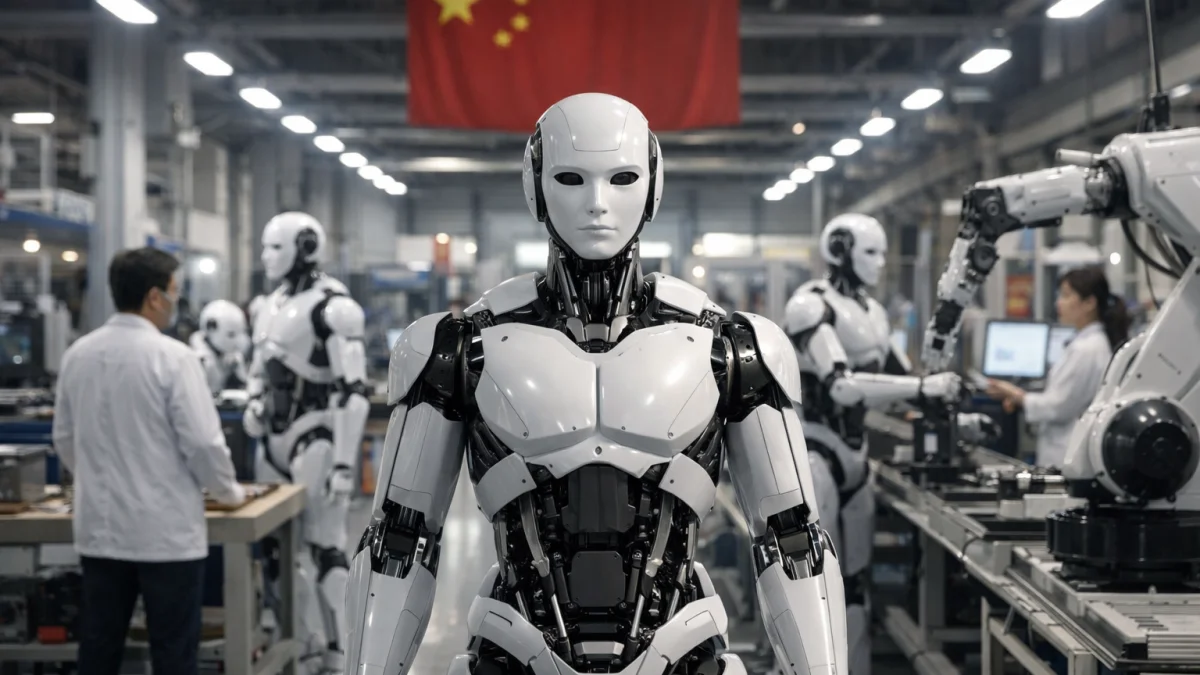


BEIJING — Chinese companies are advancing humanoid robot development and production for applications in factories and households, with significant shipments reported in 2025 and plans for expanded deployment in 2026.
The country had more than 140 humanoid robot manufacturers and over 330 models by the end of 2025, according to the Ministry of Industry and Information Technology. Leading firms including Unitree Robotics and Agibot shipped thousands of units last year, contributing to China’s dominant share of global humanoid robot production.


Unitree reported shipping more than 5,500 units in 2025, while Agibot delivered over 5,100, figures cited in industry analyses. Overall, Chinese companies accounted for the vast majority of the roughly 13,000 to 18,000 humanoid robots shipped worldwide that year.
In manufacturing, models such as UBTECH’s Walker S2 have entered pilot programs on assembly lines for new energy vehicle makers including NIO and Zeekr. The robot features capabilities for complex tasks, autonomous battery swapping and integration with production systems.
Developments for home use include prototypes aimed at chores such as cleaning, cooking and assisting elderly care. Companies like GigaAI have unveiled general-purpose household models, with testing planned for 2027 in some regions.
"Just imagine that one day in our own robot factory, our robots are assembling themselves," Yao Maoqing, a partner at Agibot, said in a Reuters report.
The advances align with national strategies prioritizing AI and robotics as drivers of economic growth under China’s five-year plans. Government support and investments have accelerated commercialization efforts, though widespread adoption in homes and full-scale factory integration remains in early stages.
Challenges include achieving reliable real-world performance beyond demonstrations, securing sufficient demand and addressing costs. Orders in 2025 came from state-owned enterprises, research labs and some private sectors for applications in power plants, data centers and services.
Industry forecasts suggest shipments could more than double in 2026, potentially reaching tens of thousands of units domestically. Mass production facilities, including lines capable of higher output rates, are operational or scaling in places such as Shanghai.
Further deployments and technological refinements are expected as companies test robots in additional real-world settings. Details on exact timelines for broad consumer availability continue to evolve.