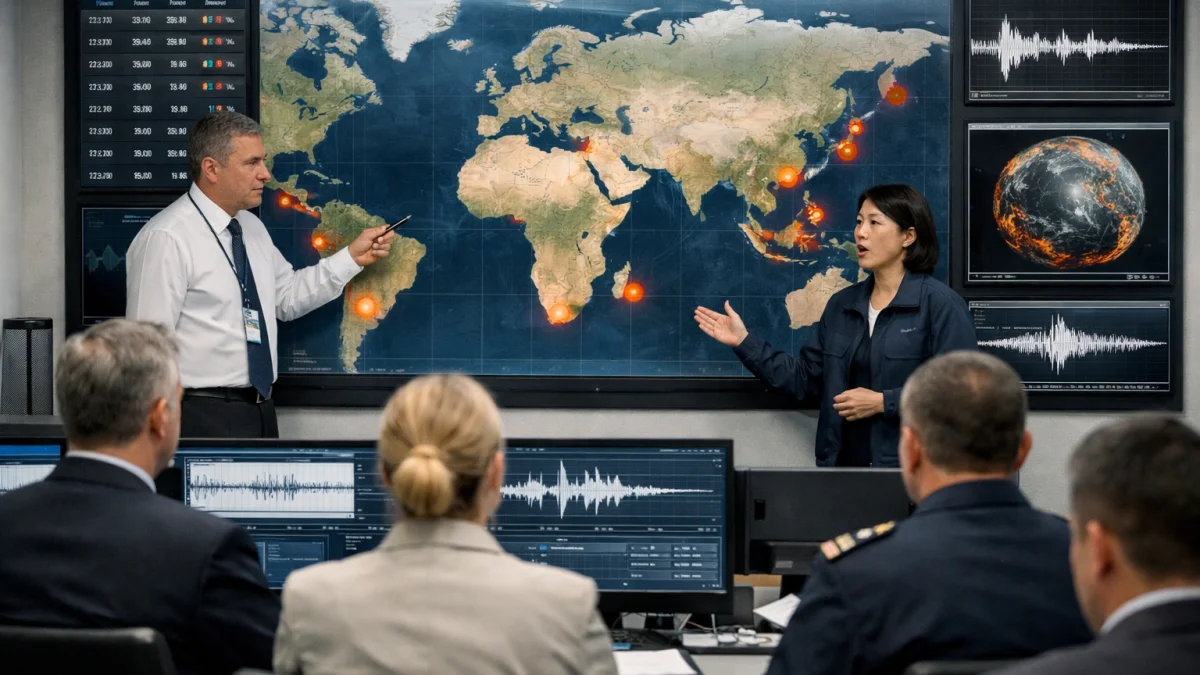
GENEVA — A series of strong earthquakes struck several regions of the world within about 24 hours, prompting emergency responses in Venezuela, Japan and the United States, while seismologists said there was no evidence the geographically distant events were connected.
The most destructive earthquakes occurred in northern Venezuela on Wednesday, where two powerful tremors struck within seconds of each other. Venezuelan authorities said the quakes caused widespread damage, while rescue operations continued on Thursday amid collapsed buildings and disrupted infrastructure. Officials said casualty figures were expected to change as search efforts continued.
According to the U.S. Geological Survey, other notable earthquakes during the same period included a magnitude 7.2 event off Japan's northern coast and a magnitude 5.6 earthquake in Northern California. Both earthquakes prompted inspections and emergency assessments, although authorities did not report damage on the scale seen in Venezuela.
The close timing of the earthquakes prompted discussion on social media about whether the events were linked. Earthquake experts rejected that suggestion, saying the earthquakes occurred on separate fault systems in different tectonic settings. William Barnhart, a geophysicist with the U.S. Geological Survey, told media outlets that the timing was "a coincidence," while Martin Hudson, a geotechnical engineering expert at the University of California, Los Angeles, said long-distance triggering between the Japan, California and Venezuela earthquakes was not supported by available evidence.
Scientists noted, however, that the two Venezuelan earthquakes were likely related because they occurred close together in both time and location. According to Hudson, "The shaking of the first earthquake increases the stress on a nearby fault. If the other one was close to going off anyway, it wouldn't take much to set it off."
The U.S. Geological Survey said earthquakes of magnitude 7 or greater occur worldwide each year and are concentrated along active plate boundaries, including the Pacific "Ring of Fire." The agency said clusters of significant earthquakes can occur over short periods without indicating an unusual global seismic pattern.
In Venezuela, emergency crews and volunteers continued searching damaged buildings for survivors as aftershocks persisted. Government officials said international assistance had begun arriving, while hospitals in the hardest-hit areas remained under pressure from the influx of injured residents. Authorities cautioned that casualty totals and damage assessments remained preliminary as rescue operations continued.
As of Friday, monitoring agencies continued to track aftershocks in the affected regions. Seismologists said there was no verified evidence that the earthquakes in Venezuela, Japan and California were part of a single global seismic event, and authorities in each country remained focused on local response and recovery efforts.