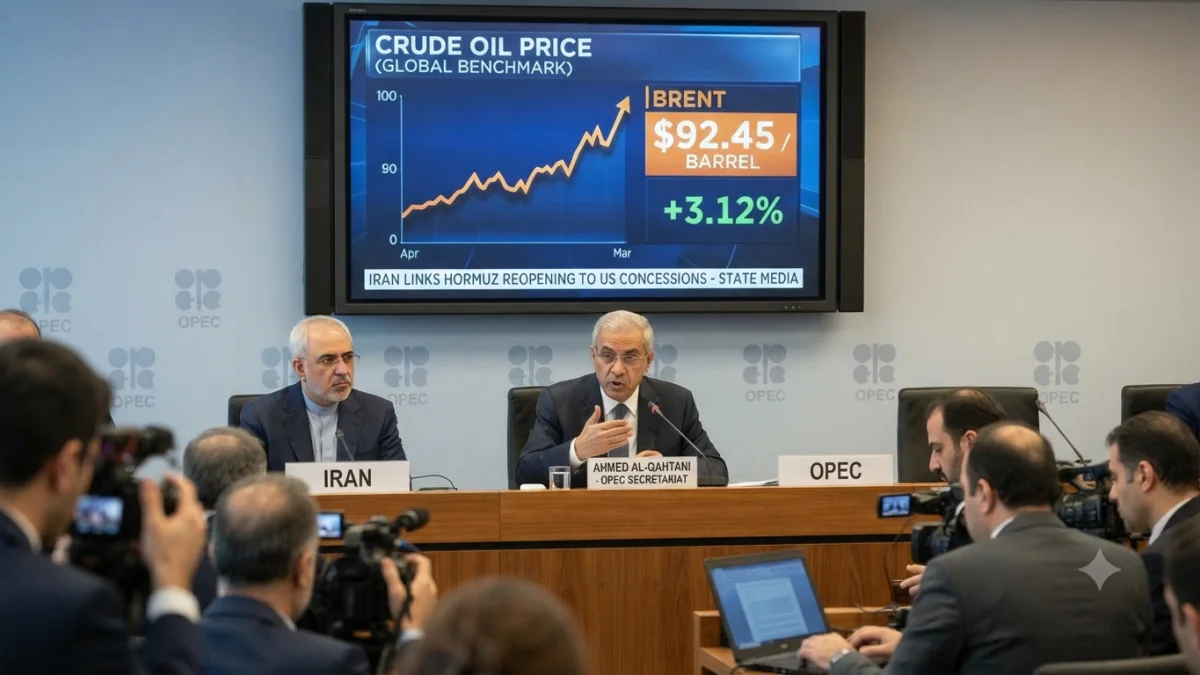


Iran’s decision to condition a full reopening of the Strait of Hormuz on concessions from the United States has reintroduced a geopolitical risk premium into oil markets, complicating hopes that a shipping agreement being negotiated with Oman would quickly restore normal energy flows. Brent crude rose to about $84 a barrel on Monday, after falling more than 7% the previous week on expectations of progress toward reopening the strategic waterway.
The significance for energy markets lies less in the immediate size of the price move than in what Iran’s position says about the durability of any reopening. The strait is a critical conduit for Middle Eastern energy exports. U.S. Energy Information Administration data show that about 20.9 million barrels per day of oil moved through Hormuz in the first half of 2025, equivalent to roughly one-fifth of global petroleum liquids consumption and about one-quarter of global maritime oil trade. Alternative pipelines in Saudi Arabia, the United Arab Emirates and Iran can bypass only part of that volume.


Iranian Foreign Minister Abbas Araqchi said Tehran was nearing an agreement with Oman on new shipping lanes through the strait, but made clear that such an arrangement would not automatically mean a full reopening. Reuters reported that Iranian conditions include compensation for damage from U.S.-Israeli attacks, an end to military threats, sanctions relief, removal of a U.S. naval blockade and the release of frozen Iranian assets. Tehran has also resisted direct negotiations with Washington unless the United States respects an interim agreement reached in June.
That distinction matters because a shipping-lane agreement and unrestricted commercial passage are separate economic questions. Even if Iran and Oman agree on routes, insurers, ship operators, oil companies and governments still need sufficient confidence that vessels can transit without attack, detention or sanctions-related complications. Reuters reported last week that disagreements also remained over which vessels would be permitted through the strait, possible transit fees and U.S. sanctions and insurance restrictions.
For oil traders, that uncertainty helps explain why prices have not fallen as far as they did when diplomatic progress appeared more likely. Brent had reached $126.41 a barrel in late April before subsequently declining as the conflict eased and expectations of restored supply increased. Asian crude imports also remained substantially below pre-conflict levels in June and July, with China’s average imports over the two months about 35% below its pre-war average, according to Reuters analysis.
The economic consequences extend beyond crude. A prolonged disruption would affect refinery feedstocks, petroleum products, liquefied natural gas and shipping costs, with the potential to transmit higher energy costs into inflation. The U.S. Energy Information Administration estimated in June that Middle Eastern producers had cut more than 11 million barrels per day of output during the disruption and that OECD oil inventories had fallen to their lowest level since 2003. It also said weaker global oil demand, partly caused by high prices and reduced fuel availability, could limit the scale of further price increases.
At the same time, the market is not responding as though a prolonged supply shock is certain. Brent remains well below its spring peak, while the EIA’s July outlook, issued after an earlier increase in shipping through Hormuz, projected that global oil production and trade flows could return close to pre-conflict levels by the end of 2026. The agency forecast an average Brent price of $74 a barrel in the third quarter and $65 in 2027, assuming supply disruptions continue to ease.
Washington has also sought to reduce the perceived strategic importance of the waterway. U.S. Treasury Secretary Scott Bessent said the strait could eventually become less relevant as alternative pipelines and routes are used, although Reuters reported that the waterway remains central to global energy trade and tanker movements through it remain limited.
The immediate economic issue, therefore, is whether the proposed Iran-Oman shipping arrangement can develop into sustained, broadly accepted commercial passage. The latest market reaction suggests traders are treating reopening as a process rather than a single event. Iran’s conditions, the U.S. response, the implementation of any shipping agreement, insurance and sanctions arrangements, and actual tanker traffic through Hormuz remain the key indicators. Until those issues are resolved, oil prices are likely to remain sensitive to each change in the diplomatic and maritime picture.