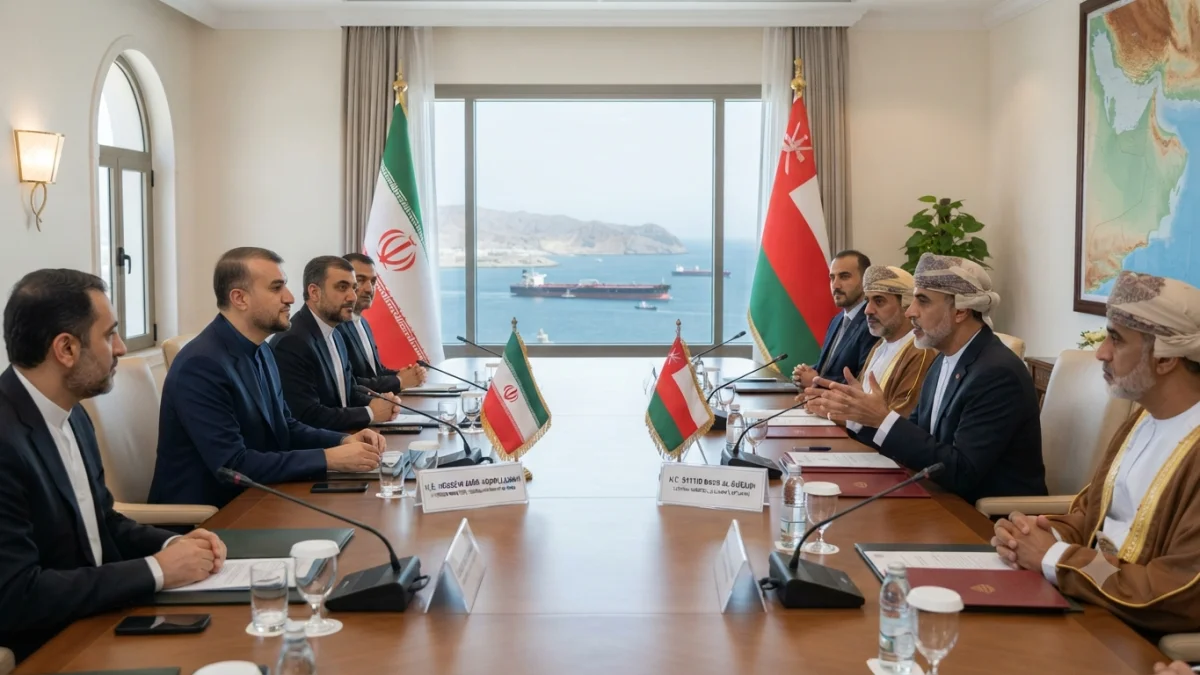


Iran and Oman’s effort to reach an agreement on navigation through the Strait of Hormuz has become a central test of whether a fragile regional conflict can be converted into a workable maritime-security arrangement, with consequences extending well beyond the Gulf. A U.S. official told Reuters on Aug. 7 that progress was being made and that Washington expected a deal soon, adding that the United States would lift its blockade of Iranian ports once an agreement restored commercial shipping “without impediments.” The official also stressed that U.S. measures would remain conditional on Iran implementing its commitments.
The significance lies in the distinction between a diplomatic understanding and an operational reopening. Hormuz is one of the world’s most important energy chokepoints: the International Energy Agency estimates that about 20 million barrels per day of crude and oil products moved through the strait in 2025, roughly one-quarter of global seaborne oil trade. Countries including Iran, Iraq, Kuwait, Qatar and Bahrain depend heavily on the waterway for exports, while alternative routes can accommodate only part of the displaced volumes.


That makes the current talks an energy-security issue as much as a diplomatic one. Earlier disruption demonstrated how quickly restrictions at Hormuz can propagate through oil markets. The U.S. Energy Information Administration reported that Brent crude reached $118 a barrel in April during the crisis, while Middle Eastern production was curtailed as producers struggled to move supplies. The International Energy Agency has described the resulting disruption as the largest supply shock in the history of the global oil market, with flows through Hormuz falling from roughly 20 million barrels a day before the conflict to a near standstill at the height of the disruption.
The emerging Iran-Oman framework is nevertheless more complicated than simply reopening the waterway. Reuters reported this week that one proposal would give Iran a role in controlling or intervening in inbound traffic, while vessels leaving the Gulf would use a route coordinated with Oman and notify Iranian authorities. The shipping industry has raised legal, insurance and financial concerns over such an arrangement. A separate Reuters report said Iran was seeking fees equivalent to 5% to 7% of cargo values, while Oman was considering a lower figure and Washington opposed charges. U.S. sanctions and insurance restrictions could also make payments to an Iranian maritime authority difficult for commercial operators.
Those issues explain why a political announcement would not necessarily translate into an immediate recovery in energy flows. For shipowners, the relevant question is whether vessels can transit repeatedly under predictable rules, obtain insurance, secure cargoes and avoid military interference. The International Maritime Organization has emphasized that transit rights through international straits should not be threatened or impeded and that coastal-state measures governing traffic must comply with international maritime rules.
Oman’s role is therefore unusually important. As one of the two states whose territorial waters include parts of the strait, it has maintained a diplomatic channel with Tehran while also emphasizing freedom of navigation. In June, Oman and Iran reaffirmed their commitment to safe passage consistent with international law, and in July their foreign ministers agreed to continue technical and political discussions on navigation arrangements. Oman has separately stated that it remains committed to its obligations under the U.N. Convention on the Law of the Sea.
The economic stakes also extend beyond crude oil. Hormuz is a major route for liquefied natural gas, particularly supplies from Qatar. EIA data show that oil flows through the strait averaged 20.4 million barrels per day in the first quarter of 2025, compared with 14.6 million barrels per day in the first quarter of 2026 amid the disruption; LNG flows also declined substantially. For Asian importers, prolonged uncertainty can therefore affect crude, refined products, LNG, freight costs and inflation simultaneously. The IEA has specifically warned that the crisis exposed structural energy vulnerabilities in Southeast Asia, where demand is growing and dependence on imported fuels remains significant.
The latest talks also illustrate how closely maritime security has become tied to the broader U.S.-Iran conflict. Washington has linked the lifting of its blockade to implementation of a shipping agreement, while Tehran has continued to frame navigation arrangements in terms of its sovereignty and security concerns. Reuters reported that the proposed framework remains one of the principal obstacles to resolving the wider confrontation.
For global energy markets, the immediate issue is therefore not whether diplomats declare progress, but whether commercial traffic can return under rules that governments, insurers and shipowners regard as credible. The current confirmed position is that Iran and Oman are making progress and that Washington expects a deal soon, but key operational and legal details remain unresolved. International maritime authorities continue to monitor navigational safety, while energy markets remain sensitive to evidence that shipping is actually resuming.