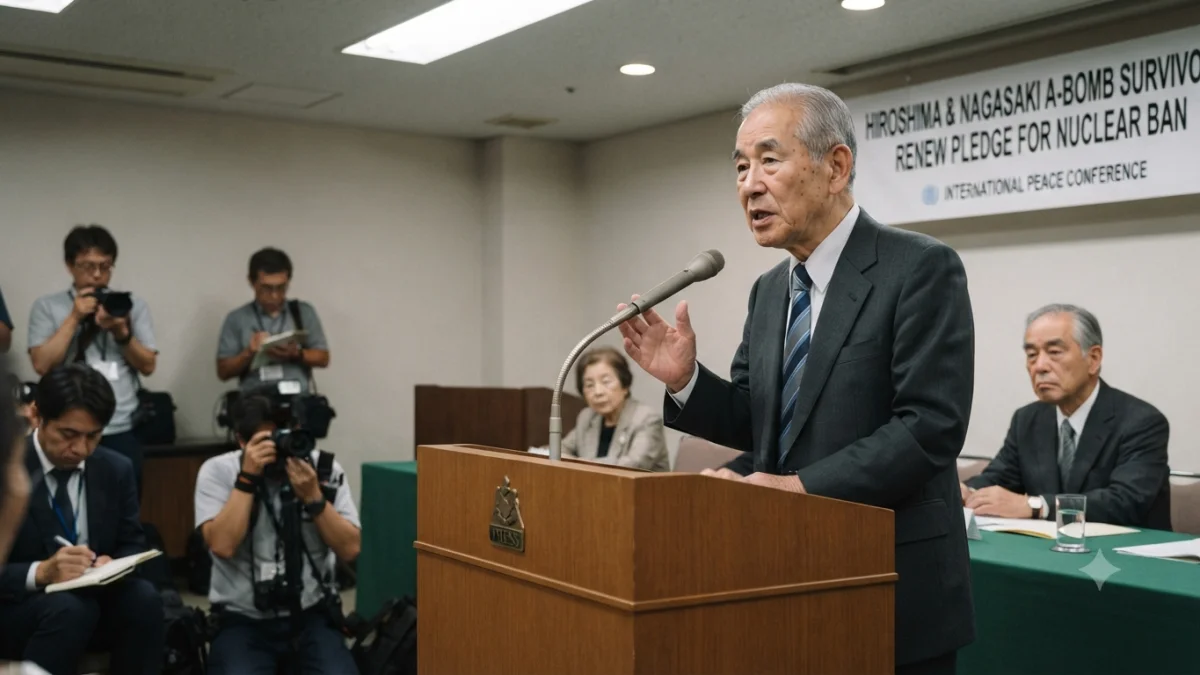


NAGASAKI — Japan’s leading organization of atomic bomb survivors renewed its commitment on Saturday to campaigning for the abolition of nuclear weapons, as Nagasaki marked the 81st anniversary of the U.S. atomic bombing amid growing international nuclear tensions.
Nihon Hidankyo, the Japan Confederation of A- and H-Bomb Sufferers Organizations, has continued to press Japan and other countries to pursue nuclear disarmament. The group won the 2024 Nobel Peace Prize for its efforts to document the experiences of hibakusha, or atomic bomb survivors, and advocate for a world without nuclear weapons.


The group’s renewed pledge comes as Japan faces debate over its longstanding three non-nuclear principles — not possessing, producing or allowing the introduction of nuclear weapons — and as nuclear-armed states modernize their arsenals.
Prime Minister Sanae Takaichi said at the Nagasaki Peace Memorial Ceremony that Japan was “upholding” the three principles. She also said Japan would pursue “realistic and practical” efforts toward a world without nuclear weapons, according to her address.
Nagasaki Mayor Shiro Suzuki warned that reliance on nuclear deterrence carried risks. In his Peace Declaration, he described nuclear weapons as an “absolute evil” that could not coexist with humanity and urged the government to uphold the three non-nuclear principles.
The ceremony took place at 11:02 a.m., the time the U.S. B-29 bomber dropped the plutonium-based bomb known as “Fat Man” over Nagasaki on Aug. 9, 1945. The attack killed about 74,000 people in the city by the end of that year, according to historical estimates cited at the ceremony.
The anniversary also followed the failure of the latest Nuclear Non-Proliferation Treaty review conference in May to agree on a final document, the third consecutive conference to end without consensus. Suzuki urged Japan to participate in a later 2026 conference on the Treaty on the Prohibition of Nuclear Weapons.
Nihon Hidankyo has separately faced questions about its future as the survivor population declines. The group plans to hold a vote in June 2027 on whether and how it should continue, with its members emphasizing the need to pass survivors’ experiences to younger generations.
Japan’s officially recognized hibakusha population fell to 91,105 as of July 2026, while their average age rose to 86.66, underscoring the shrinking number of survivors able to give firsthand accounts of the bombings.