

In Crooksville, Ohio, the water came into Kaitlyn Rodgers’ home before dawn on Tuesday, rising to knee depth and trapping her, her husband and their four children inside.
The family could not safely make their way out. The current was too strong, according to Rodgers, and firefighters eventually arrived by boat to rescue them in the darkness.


“Water just started pouring into the house,” Rodgers told The Associated Press. Because the house was old, she said she feared for her children when water reached electrical outlets near the floor.
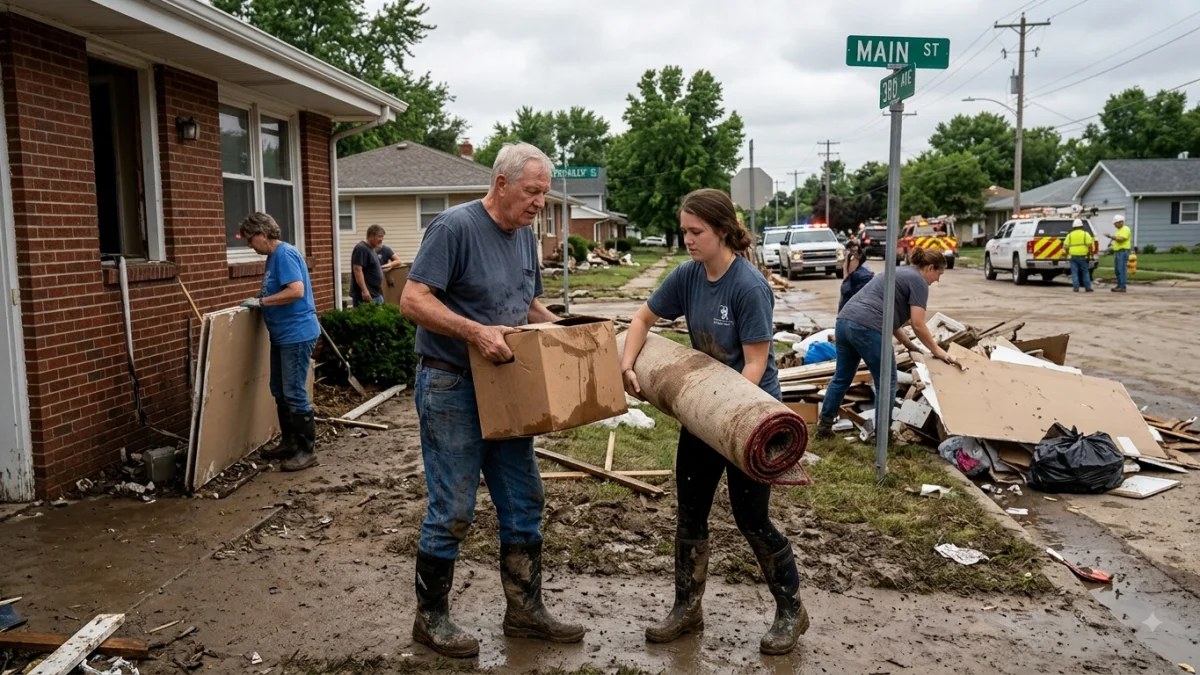
By Wednesday, the immediate task across parts of the Midwest was no longer simply escaping the flood. It was beginning the slower work of recovery: clearing trees and power lines, assessing damaged homes, reopening roads and trying to restore electricity while more severe weather remained possible.
The storms that struck the region beginning Tuesday brought a combination of torrential rain, flash flooding, tornadoes and powerful straight-line winds across parts of Illinois, Indiana, Ohio, Kentucky and West Virginia. The National Weather Service confirmed tornadoes south of Chicago, while a preliminary assessment indicated that the storm system moving from Iowa into Indiana qualified as a derecho, a long-lived windstorm capable of producing widespread damage.
For residents, the scale of the disruption was measured in very practical terms.
More than 650,000 electricity customers across five states were without power Wednesday afternoon, according to PowerOutage.us. American Electric Power, based in Columbus, said it had identified more than 100 broken poles, about 650 downed wire spans and another 85 tangled with trees. Its crews had restored electricity to 135,000 customers, but about 76,000 remained without service.
In Indiana, the damage was particularly extensive. More than 234,000 customers were without electricity in one update from PowerOutage.us, while Northern Indiana Public Service Co. said damage to poles, power lines and trees could mean that restoration would take days in some areas.
For people whose homes flooded, power was only one part of the problem.
Michelle Wilson, who lives in Cambridge City, Indiana, about 20 miles from the Ohio border, was left facing extensive flood damage to her home. AP reported that Wilson did not have flood insurance and was uncertain how she would pay for repairs.
That uncertainty is one of the less visible stages of a disaster. Once floodwater recedes, the physical signs remain: damaged property, contaminated or ruined possessions, disrupted transportation and bills that can arrive long after emergency crews leave.
The same pattern was evident farther east in Ohio, where communities faced both flooding and the aftermath of powerful winds.
In Athens County, nearly 300 people called 911 for help on Tuesday, including 42 calls involving vehicles stranded in floodwaters, according to emergency management director Teresa Fouts-Imler. More calls came Wednesday as floodwaters moved toward the Ohio River.
Ohio Gov. Mike DeWine sent 40 Ohio Army National Guard members to assist in two counties east of Columbus. Local emergency departments, including teams from West Virginia, also joined rescue operations. After surveying the affected areas by helicopter, DeWine described the flooding as “stunning” and said the communities had been hit in a “historic way.”
The response unfolded alongside a wider effort to restore basic infrastructure.
In greater Cincinnati, Duke Energy brought in 1,000 additional workers after more than 171,000 customers experienced outages over a 24-hour period. The company said crews were working with employees and contractors in Ohio and Kentucky to restore service.
For some residents, however, recovery began with clearing what the storm had left behind.
In Cincinnati, AP photographed Jim Koehler using a chainsaw to remove a damaged oak tree from his daughter’s front yard. In Chicago’s suburbs, residents confronted downed trees, damaged roofs and prolonged power failures. Javid Jenkins of Homewood, Illinois, told AP that he had been driving around looking for gasoline to operate a generator and protect food in his refrigerator.
“No power. It was very scary. We were down in the basement,” Jenkins said. “We’re built for snow. We’re built for cold. We’re not built for this.”
His observation captures one of the challenges exposed by the storms: communities accustomed to preparing for familiar Midwestern hazards were suddenly dealing with an unusually complicated combination of flooding, extreme wind and infrastructure failures.
The weather also complicated the recovery itself. The National Weather Service warned that severe thunderstorms and heavy rainfall threats would continue across the Plains, Midwest, Ohio Valley and central Appalachians in the following days. Flood watches and warnings remained in effect across portions of the region.
That meant residents and emergency workers could not assume that the first cleanup would be the last.
The storms had already claimed lives. A four-year-old boy in Geneva, Indiana, was killed when a tree fell on his home, according to the Jennings County Sheriff’s Office. In Roseville, Ohio, DeWine said a resident died during a health emergency after flooded roads prevented first responders from reaching them. Officials in Portage, Indiana, were also investigating whether severe weather contributed to a house explosion that killed one person.
Sixteen incarcerated people were injured when lightning struck a prison complex southwest of Cleveland, with four still hospitalized Wednesday, including one with severe injuries, according to the Ohio Department of Corrections.
The recovery therefore carries a weight beyond repairing roofs or restoring electricity. In communities where roads themselves became obstacles to emergency response, residents have been reminded how quickly ordinary systems can become inaccessible.
Yet the first steps of recovery are often ordinary ones.
A generator needs fuel. A damaged tree needs to be removed. A flooded house needs to be inspected. A road needs to reopen. Electricity crews need to reach broken poles and reconnect lines. Families need somewhere safe to sleep while deciding what can be salvaged and what cannot.
For Rodgers and her family in Crooksville, the immediate crisis ended when firefighters reached their home by boat. For Wilson in Cambridge City, the next challenge is confronting the cost of repairing a flooded home without flood insurance. Across the region, thousands of other households are beginning their own versions of the same process.
By Thursday, about 540,000 homes and businesses across the Midwest were still without power, according to PowerOutage.us, with Indiana accounting for more than 267,000 outages. Utility crews were continuing repairs while forecasters warned that additional severe thunderstorms and downpours could bring new flooding.
For residents, recovery was therefore not a single moment when the water disappeared. It was the beginning of a longer sequence of decisions, repairs and waiting — undertaken while the weather itself remained uncertain.