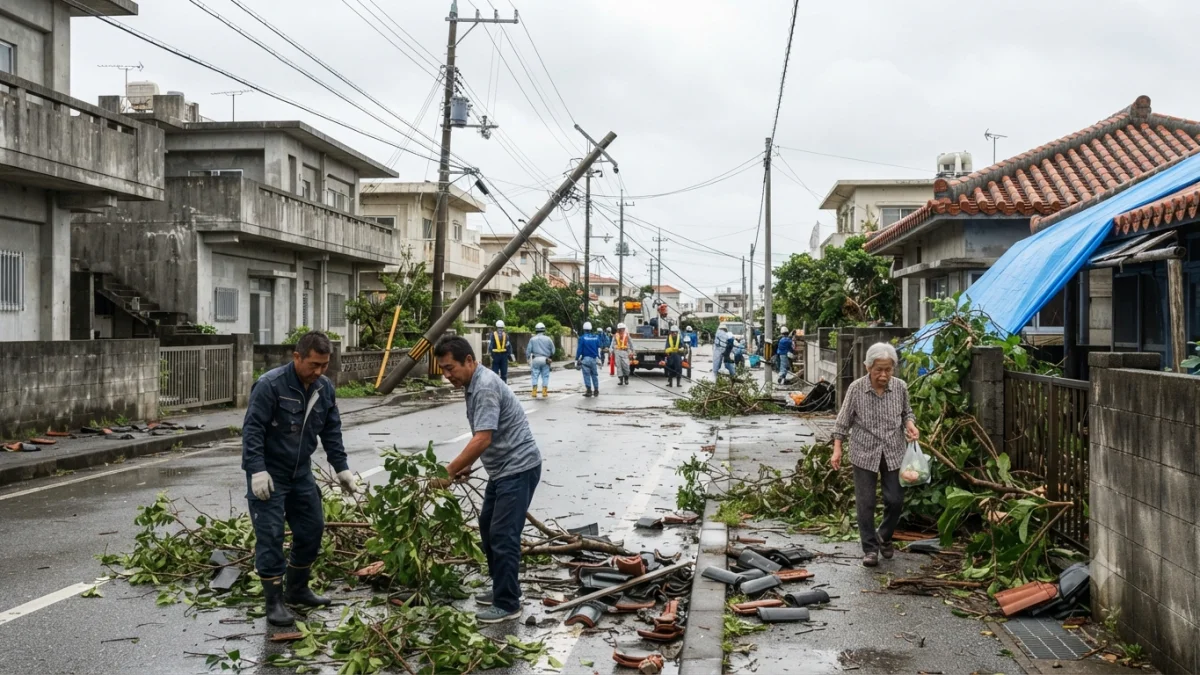


Typhoon Dolphin left Okinawa residents facing a quieter but difficult task on Sunday: beginning the work of recovery after powerful winds knocked out electricity, disrupted transport and sent some people to evacuation centres.
The storm struck Japan’s southern Okinawa prefecture on Saturday, bringing maximum sustained winds of 162 kph and gusts reaching 216 kph, according to Reuters reporting based on Japanese authorities. More than 12,000 buildings in Okinawa lost power, while outages across Okinawa and neighbouring Kagoshima prefecture affected more than 50,000 buildings.


For residents, the storm’s passage did not immediately mark the end of the disruption. Power, communications and transport are among the basic services that determine how quickly daily life can resume after a typhoon. Okinawa’s authorities had warned before the storm that power outages, water shortages and logistics disruptions could continue even after Dolphin passed.
The scale of the interruption was significant but uneven. Okinawa accounted for just over 12,000 of the reported outages, while nearly 39,000 buildings in Kagoshima were without electricity, according to the Reuters report. Airlines also cancelled flights to and from Okinawa, leaving travellers unable to move normally through the region.
Around 240 people sought refuge at evacuation centres across Okinawa as the typhoon approached, according to Associated Press reporting. The storm also caused injuries: authorities said six people were hurt in Okinawa and Kagoshima, including five elderly people in Okinawa, three of whom fell because of the strong winds. None of the reported injuries was life-threatening.
Those numbers offer a measure of Dolphin’s physical impact, but the experience of a power outage is more ordinary and immediate. When electricity disappears, refrigeration, lighting, communications and other household routines can be interrupted at once. In an island prefecture accustomed to typhoons, preparation is part of daily disaster management, but preparation does not eliminate the work required afterward.
Okinawa Electric Power maintains a 24-hour service for power-outage and emergency inquiries, reflecting the importance of electricity restoration during such events. The company advises customers experiencing an outage to check their circuit breakers, while transmission and distribution facilities are handled through its emergency and inquiry system.
Dolphin was the latest in a season that has already tested Okinawa. Japan’s Meteorological Agency recorded four typhoons approaching Okinawa and the Amami region by late July 2026, including three in June and one in July. The agency defines an approach as the centre of a typhoon coming within 300 km of Okinawa or the Amami Islands.
That history matters because recovery in Okinawa is not simply about clearing the immediate effects of one storm. Residents, businesses and public authorities have to restore services while preparing for the possibility of another disruption. Research on typhoon impacts in Okinawa has similarly emphasized the importance of residents, municipalities and other organizations sharing information and coordinating disaster preparedness.
Dolphin also arrived as parts of southern Japan were dealing with other recent damage. In Kyushu, authorities had been concerned about the additional effects of heavy rain and strong winds on communities whose homes had already been damaged by a recent earthquake. Residents in some areas used blue tarps to protect exposed parts of buildings, according to AP.
By Saturday, however, Dolphin was already moving beyond Japan. Its next threat was China’s eastern coast, where authorities prepared for heavy rain, flooding and landslides and suspended or restricted port, ferry, aviation and construction activity.
For Okinawa, the immediate priority was different: restoring the infrastructure that allows households and businesses to return to ordinary routines.
The storm had demonstrated again how quickly a typhoon can turn electricity and transportation from invisible conveniences into critical lifelines. For the people who remained in Okinawa through Dolphin, recovery was therefore measured not by the storm’s departure from weather maps, but by the gradual return of the services that make everyday life possible.