

Puerto Rico’s Water Clock Turns Off as Drought Deepens
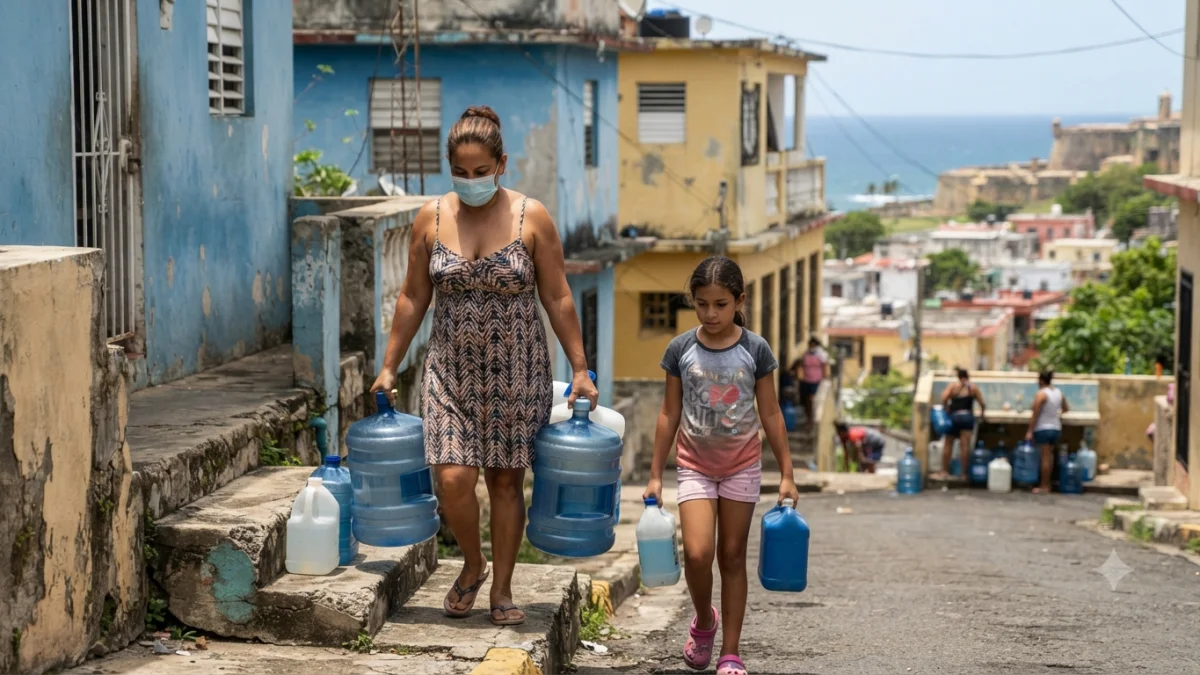
On June 10, Bryan Pérez carried a five-gallon water jug to his apartment in the Villa Kennedy public housing complex in San Juan. The image captured a routine that has become increasingly familiar in Puerto Rico: securing water not from a household tap, but by hauling it home in containers.


Now that routine is being imposed on tens of thousands more people.
Beginning Friday, Puerto Rico started rotating water service in parts of San Juan and six other municipalities, leaving more than 180,000 customers without running water for 48 hours at a time. The schedule is expected to remain in effect at least through August, although officials say they cannot predict when normal service will return.
For families, the drought has transformed an ordinary household resource into something that must be scheduled, stored and rationed. Water must be available for drinking and cooking, while washing, bathing, flushing toilets and other daily needs compete for what remains.
The immediate trigger is the weather. San Juan recorded its driest July in more than 120 years, according to the National Weather Service. Nearly 68% of Puerto Rico is experiencing drought conditions, according to the U.S. Drought Monitor, with almost a quarter of the island classified as being in severe drought.
The outlook offers little reassurance. The National Oceanic and Atmospheric Administration projects a greater than 70% chance of below-normal rainfall and above-normal temperatures from August through October. A strengthening El Niño pattern is expected to suppress some of the tropical weather systems that normally bring rainfall to the island.
The water shortages, however, did not begin with this drought.
In San Juan and other communities, residents had already been reporting prolonged interruptions linked to problems that include the territory’s aging water infrastructure. In May, San Juan Mayor Miguel Romero sued Puerto Rico’s Water and Sewer Authority over persistent outages. Governor Jenniffer González has acknowledged that the system has suffered from decades of insufficient investment and maintenance.
For residents who have spent months dealing with unreliable service, the new rationing schedule therefore does not necessarily mark the beginning of a crisis. It formalizes one that many say they were already living through.
Marcia Soler París, a 61-year-old community leader, told The Associated Press that her neighborhood had been experiencing severe shortages for months. The official rationing schedule, she said, offered little comfort when residents already could not depend on their taps.
“It’s chaos,” Soler París said. “It’s truly pitiful.”
Her greatest concern was for older and bedridden residents who cannot easily carry heavy containers of water to their homes.
That burden has fallen particularly hard on people living in communities where water must be collected manually. Earlier this year, Jeannette Mercado Rodríguez, a resident of a San Juan public housing complex, described carrying five buckets and multiple two-liter bottles to her third-floor apartment each day after water shortages left residents dependent on a tanker truck. She injured her shoulder while doing so, according to reporting published in June.
The shortages also carry a financial cost. Residents have reported buying drinking water, paying for laundromats and finding other ways to meet basic household needs when service disappears. Community leaders have raised concerns about the elderly and people with disabilities, for whom moving containers of water can be physically difficult or impossible.
The government has tried to bridge the gap with water trucks. Luis González Delgado, president of the Puerto Rico Aqueduct and Sewer Authority, said trucks would distribute potable water in affected communities, with hospitals and residences for older people receiving priority.
The authority has also urged residents to conserve water while service is available and avoid nonessential uses such as washing cars and watering lawns. When service resumes, residents have been advised to boil water for at least three minutes as a precaution against possible contamination.
The first phase of the new rationing plan covers areas supplied by the Carraízo reservoir, which authorities say has reached critically low levels. The affected territory includes parts of San Juan as well as neighborhoods in Carolina, Juncos, Gurabo, Trujillo Alto, Canóvanas and Loíza. Communities have been divided into two zones that alternate between 48 hours with water and 48 hours without it.
Puerto Rico has used rationing before. In 2015, some 400,000 utility customers received water only every third day. Similar measures were introduced again in 2020.
But the current crisis arrives after years in which unreliable infrastructure has already made water access uneven. A May letter from Resident Commissioner Pablo José Hernández to the water authority cited repeated disruptions, including a March power outage at the Carraízo dam that knocked three major pumps offline and disrupted service across parts of the metropolitan area. The letter also cited Morovis, where residents had endured 42 consecutive days without water during one episode amid a longer pattern of outages.
Drought is now adding another pressure to a system already struggling to deliver consistently.
For Puerto Rico’s families, that means the household calendar is increasingly organized around the water supply. The government schedule determines when taps may run; residents must decide what can be stored, what can be used and what can wait.
Governor González has acknowledged that the duration of the rationing remains uncertain. “This situation is out of our hands,” she said, attributing the measures to the climate conditions facing the island.
For residents such as Soler París, however, the crisis is measured less by forecasts than by the reliability of the tap. As the island waits for rain that may not come soon, the question is no longer simply whether Puerto Rico has enough water. It is how families manage ordinary life when access to it arrives by the clock.