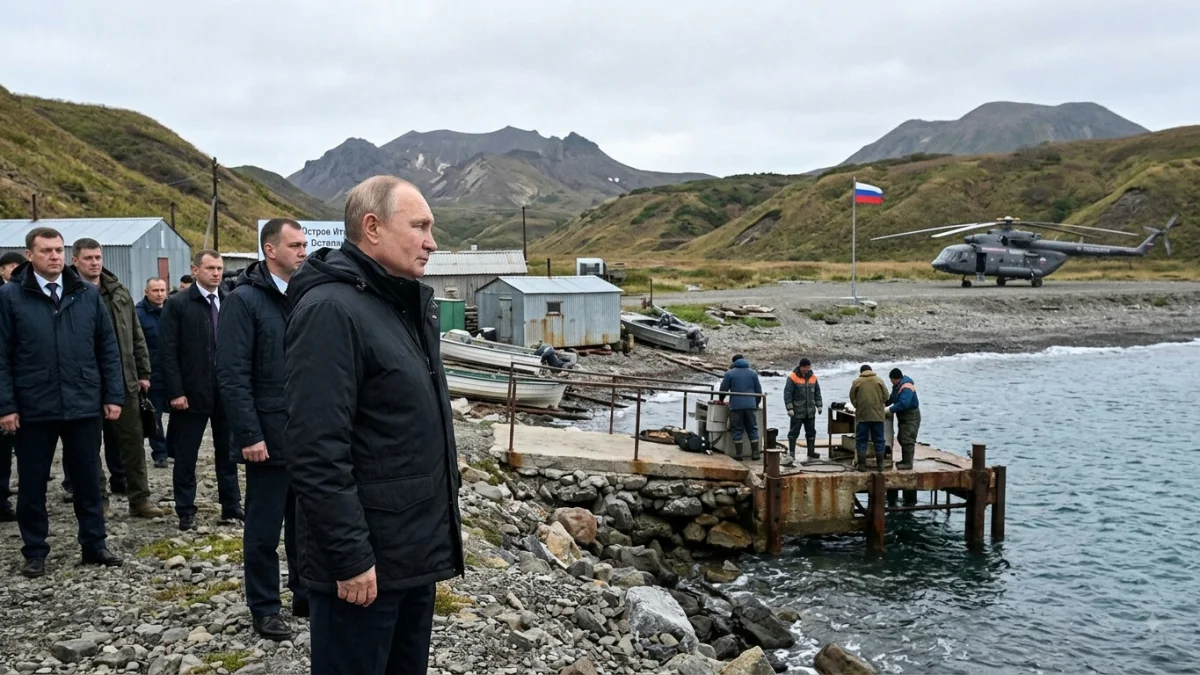


Russian President Vladimir Putin’s visit to Iturup, one of the four southern Kuril Islands claimed by both Russia and Japan, has brought a long-running territorial dispute back into sharp diplomatic focus, at a time when relations between the two countries are already close to their lowest point in decades. The Aug. 13 visit was Putin’s first to the disputed island chain and prompted Japan to summon Russia’s ambassador and issue a strong protest.
The significance extends beyond the symbolism of a presidential visit. The islands, known in Japan as the Northern Territories and in Russia as the Southern Kurils, have remained the central obstacle to a formal peace treaty between the two countries since World War Two. Japan maintains that the four islands are inherently Japanese territory, while Russia asserts sovereignty over them based on the postwar settlement. Putin’s appearance on Iturup therefore reinforces a territorial position that Moscow has shown little willingness to compromise on, while underscoring how limited the prospects are for restoring the diplomatic negotiations that once offered a possible route to a settlement.


Japan’s response reflected both the legal and political importance it attaches to the dispute. Prime Minister Sanae Takaichi described the visit as “absolutely unacceptable,” while Foreign Minister Toshimitsu Motegi reiterated Tokyo’s claim to the four islands and summoned the Russian ambassador. Moscow rejected Japan’s protest and reaffirmed Russian sovereignty, making clear that the two governments remain fundamentally opposed over the islands’ status.
The dispute has become more difficult to manage since Russia’s invasion of Ukraine in 2022. Moscow suspended peace-treaty negotiations, halted several arrangements involving former Japanese residents and withdrew from dialogue on joint economic activities on the islands, citing Japan’s sanctions and broader policy toward Russia. Japan, for its part, has maintained sanctions in coordination with its Group of Seven partners while continuing to state that resolving the territorial issue remains necessary for a peace treaty.
That breakdown means Putin’s visit is occurring in a diplomatic environment very different from the period when former Japanese Prime Minister Shinzo Abe pursued closer engagement with Moscow. As recently as February, Kremlin spokesman Dmitry Peskov said there was no peace dialogue with Japan and described bilateral relations as having been reduced to zero. Takaichi nevertheless said Japan’s position on resolving the territorial issue and concluding a peace treaty remained unchanged.
The islands also have significance beyond their historical and legal dispute. Japan’s Defence Ministry has documented increased Russian military activity in the area, including the deployment of coastal anti-ship missiles, air-defense systems and aircraft. Japanese assessments say Russia has strengthened its military posture around the Kurils and adjacent areas partly to protect the wider Sea of Okhotsk, an important operating area for Russian strategic submarines.
This gives the territorial issue a direct security dimension for Tokyo. Japan’s latest defence assessments describe Russia’s military activity around the Northern Territories as a concern while also pointing to closer military cooperation between Russia and China. The broader regional environment is already complicated by China’s expanding military capabilities and North Korea’s missile and nuclear programs.
For Moscow, meanwhile, the visit publicly reinforces its administration of territory it has controlled since the Soviet Union took the islands at the end of World War Two. Russian officials have consistently rejected Japan’s description of the islands as illegally occupied and instead argue that their sovereignty was settled by the postwar agreements. The immediate exchange of protests therefore changes little about the legal positions of either side, but it further reduces the space for diplomatic ambiguity.
The timing is also significant. Putin’s visit came shortly before Japan’s Aug. 15 commemoration marking the end of World War Two, adding historical sensitivity to an already contentious territorial issue. The visit included stops at local facilities, including a school, hospital and fish-processing plant, highlighting Moscow’s presentation of the island as an established part of Russia rather than as territory whose future status remains under negotiation.
For Japan-Russia relations, the immediate consequence is therefore less likely to be a new dispute than a further confirmation of an existing diplomatic impasse. Tokyo has maintained its territorial claim and sanctions policy, while Moscow has ended peace negotiations and strengthened its administrative and military presence in the islands. Neither side has indicated a willingness to alter those core positions.
The confirmed situation is that Putin has visited Iturup, Japan has formally protested, and Russia has rejected the protest while reaffirming its sovereignty claim. The broader question remains whether either government will eventually reopen negotiations over the Northern Territories and a peace treaty. For now, officials are monitoring Russian military and administrative activity in the disputed islands, Japan’s response to that activity, and any changes in the two countries’ diplomatic contacts.