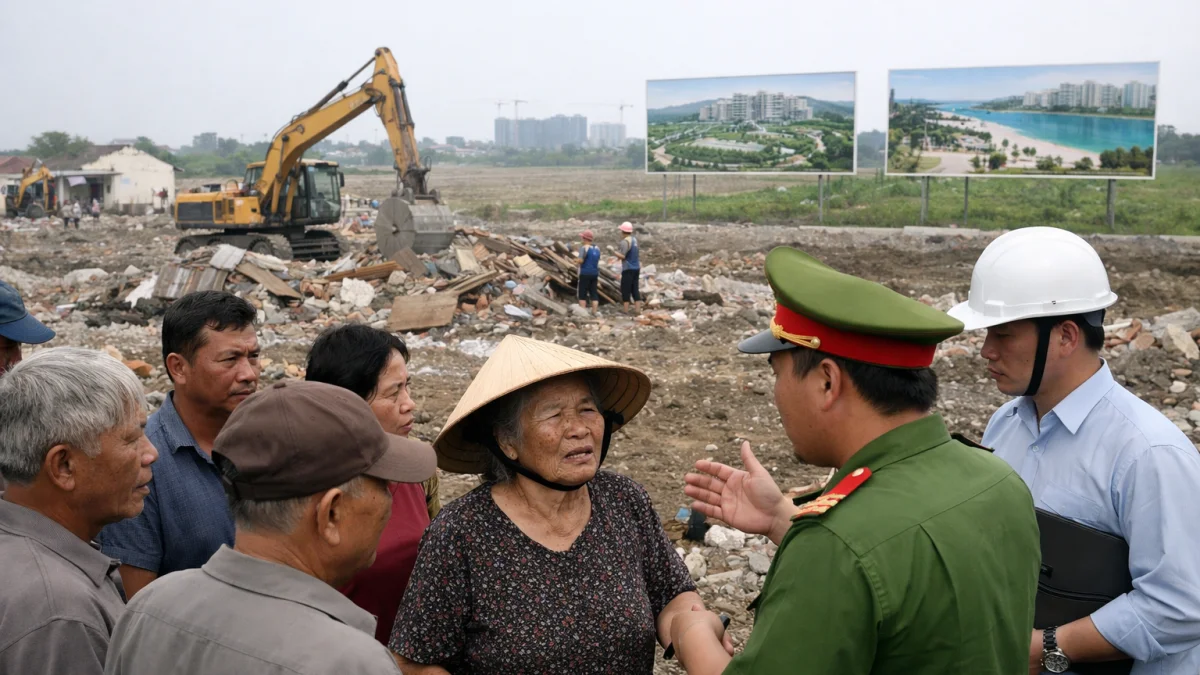
CHAU NINH COMMUNE, Hung Yen Province, Vietnam — On a recent morning in Chau Ninh commune, dozens of police officers moved into fields where rice and fruit trees had long sustained local families. By 7 a.m. on June 26, authorities began enforcing the handover of the first plots for a sprawling $1.5 billion development. Among those watching was Khanh Huyen, a 46-year-old farmer whose family stood to lose 540 square meters planted with fruit trees that had generated up to 100 million dong (about $4,900) a year.
The scene marked a new phase in the state’s effort to clear land for the Trump International Hung Yen project, a luxury complex of hotels, golf courses, residential estates and eco-tourism facilities. Developed in partnership with local firm Hung Yen Hospitality Services, a subsidiary of industrial park developer Kinh Bac City, and branded by the Trump Organization, the project spans roughly 900 to 990 hectares across communes in Khoai Chau district.
For residents whose families have farmed this Red River Delta land for generations, the transformation represents both disruption and the promise of broader provincial development. Vietnam’s legal framework allows compulsory land acquisition for projects deemed in the public or socio-economic interest, a mechanism used across the country for urban expansion and large investments.
Khanh Huyen’s situation illustrates the immediate stakes. Her family’s orchard, cultivated over decades, provided steady income in a region where agriculture remains central to many livelihoods. Local officials have issued eviction notices, with enforcement actions following for those who have not yet agreed to compensation terms.
The project is expected to affect around 4,000 households. In one early phase, 145 households accepted compensation and relocated, with authorities disbursing roughly $2 million for that initial group, according to local government reports. Many more remain in various stages of negotiation.
Some residents have voiced concerns over the adequacy of offers. Reports from earlier this year described farmers questioning compensation rates relative to the productive value of long-held agricultural plots and the project’s ultimate luxury positioning. Others, interviewed near the groundbreaking site last year, expressed conditional support tied to fair payouts.
Beyond cropland, preparations have involved relocating ancestral graves, a culturally significant process in Vietnamese communities where family burial sites carry deep meaning. Families have exhumed remains and marked plots to indicate transfers, according to accounts from the area.
Provincial authorities and project representatives maintain that compensation follows legal standards and that the development will bring jobs, infrastructure and economic growth to Hung Yen, a province strategically located near Hanoi. Prime Minister Pham Minh Chinh attended the groundbreaking ceremony in May 2025 alongside Eric Trump, emphasizing benefits for local people.
Hung Yen has precedent for large-scale land conversions. Earlier projects, such as the Ecopark urban development in Van Giang district, also involved significant acquisitions and sparked protests over compensation and consultation. Nationally, hundreds of thousands of hectares of agricultural land have shifted to non-farm uses in recent decades, affecting millions of rural households.
Under Vietnamese law, the state manages land on behalf of the people, granting use rights that can be revoked for approved projects. Officials argue such developments serve national modernization goals, particularly in attracting foreign investment amid Vietnam’s economic integration. The Trump-linked project, valued at approximately $1.5 billion with land use rights extending to 2075, fits this strategy. It includes multiple 18-hole golf courses, high-end hotels, villas and related amenities.
Kinh Bac City has taken a controlling stake in the venture, highlighting domestic capital’s leading role alongside the Trump Organization’s branding and management involvement. Construction timelines have shifted, with full completion eyed for around 2029, delayed in part by land clearance challenges.
Interviews and local reporting reveal a spectrum of experiences. Some households have accepted terms and begun new chapters, often citing the inevitability of state decisions. Others continue to seek higher compensation or better relocation support, navigating bureaucratic processes that can stretch for months. Community meetings and official notices form part of the ongoing dialogue, though trust varies.
Farmers like Ha Nho Son, quoted previously near project events, articulated a common sentiment: hope for reasonable compensation to offset the loss of productive land. For multi-generational families, the shift from agrarian routines to uncertain alternatives — wage labor, small businesses or resettlement — carries practical and emotional weight, even when not explicitly voiced in public records.
Experts on Vietnam’s land policy note systemic tensions. Broad interpretations of “public interest” enable commercial projects, sometimes leading to disputes when market values or livelihood impacts outpace official rates. Petitions and occasional protests have marked similar cases, though resolution typically follows administrative channels.
As enforcement actions continue in Chau Ninh and surrounding areas, the project advances toward its vision of a high-end destination along the Red River corridor. Supporters point to potential tourism boosts, employment in services and golf operations, and elevated provincial profile. Critics and affected residents emphasize the need for transparent, adequate support during transition.
Khanh Huyen and thousands of her neighbors now face the practical tasks of uprooting orchards, relocating family graves where necessary, and reimagining livelihoods on altered land. Their experiences reflect a recurring story in Vietnam’s development trajectory: the tension between national ambition and the rooted realities of rural life. How compensation is finalized, relocation supported and economic opportunities realized will shape whether this major investment becomes a shared success or a lasting point of local strain.
For now, in the fields of Hung Yen, the work of clearance proceeds under official oversight, one plot at a time.