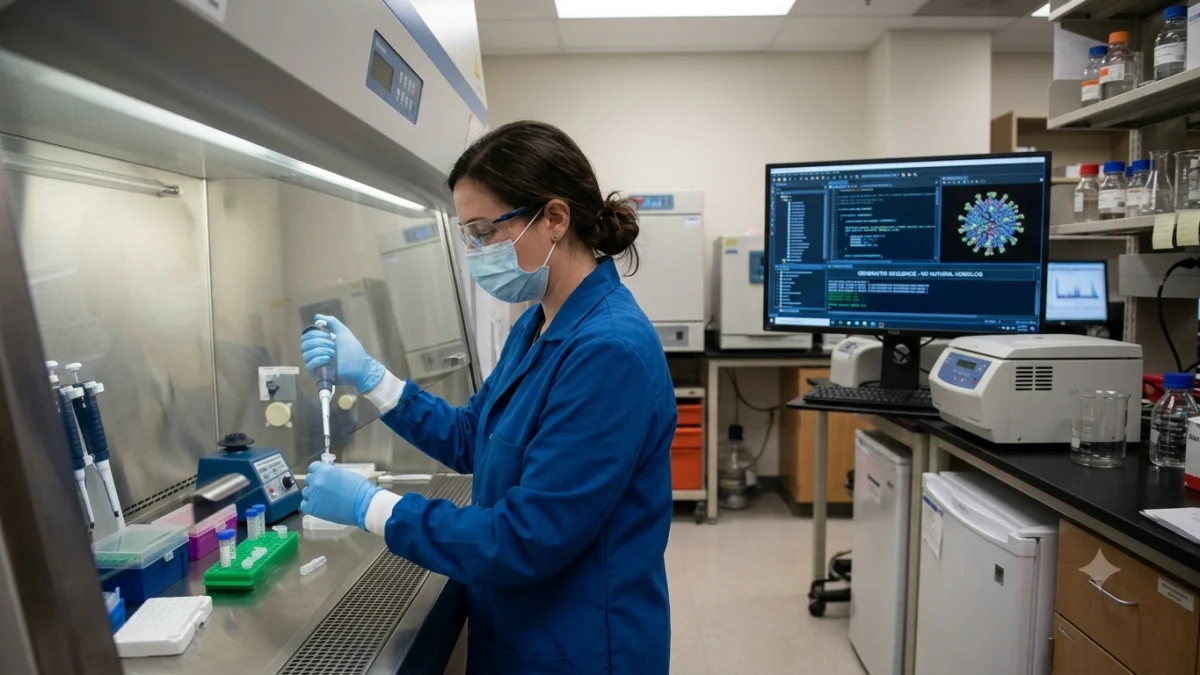


Scientists have for the first time used artificial intelligence to design viable synthetic viruses that do not exist in nature, marking a significant advance in the application of generative AI to biology while intensifying debate over biosecurity and governance. The work, led by researchers at Stanford University and the Arc Institute and published in the journal Science, resulted in the laboratory creation of 16 functional bacteriophages—viruses that infect bacteria rather than humans, animals or plants—generated from AI-designed genetic blueprints.
The achievement is significant because it moves AI beyond predicting or modifying existing biological sequences toward designing entirely new genomes that function in living systems. Until now, AI models had demonstrated increasing ability to analyze DNA and propose genetic modifications, but producing viable organisms from wholly novel genomic designs represented a more demanding scientific milestone. Researchers and outside experts say the work illustrates how advances in foundation models for biology are beginning to reshape biotechnology, drug development and synthetic biology.


The immediate scientific objective is not to create viruses that infect humans, but to improve bacteriophage therapy, an approach receiving renewed attention as antimicrobial resistance becomes a growing global health challenge. The World Health Organization has repeatedly identified antibiotic resistance as one of the world's major public health threats, prompting efforts to develop alternatives to conventional antibiotics. Because bacteriophages naturally attack bacteria, they offer a potential treatment for infections that no longer respond to existing drugs.
According to the researchers, the AI systems generated hundreds of candidate viral genomes after being trained on large collections of naturally occurring genetic sequences. Laboratory testing showed that 16 of the synthesized designs successfully infected and destroyed Escherichia coli bacteria, including strains that had developed resistance to naturally occurring bacteriophages. Several of the synthetic viruses also displayed biological characteristics distinct from known viruses, suggesting AI can explore functional genetic designs beyond those produced through natural evolution.
The findings also demonstrate how rapidly biological AI models have evolved. Earlier generations primarily assisted researchers by predicting protein structures or identifying promising genetic targets. Newer genome-scale language models, including those used in the study, are increasingly capable of generating complete genetic sequences that can be synthesized and tested experimentally. Scientists describe this as a shift from AI serving as an analytical tool to becoming a design platform for biological engineering.
The advance nevertheless highlights longstanding concerns surrounding dual-use research—scientific work that has legitimate civilian applications but could also be misused. Biosecurity specialists have argued that AI capable of designing functional biological systems could eventually lower technical barriers for developing harmful pathogens or biological agents. Although the viruses produced in the current study infect only bacteria and the researchers deliberately excluded human-infecting viruses from the training process, experts say the broader technological trajectory warrants closer oversight.
Researchers involved in the project and independent experts have also stressed important limitations. Designing and validating functional viruses still required specialized laboratories, DNA synthesis, biological testing and expert scientific judgment. The AI system did not autonomously create dangerous pathogens, nor does the study demonstrate an immediate capability to generate viruses that threaten humans. Several specialists have argued that modifying existing pathogens remains a more practical concern than creating entirely new ones from scratch, although future AI advances could alter that assessment.
The publication arrives amid broader efforts by governments, scientific institutions and industry to strengthen safeguards for AI-enabled biotechnology. Recent reports from the U.S. National Academies, the National Institute of Standards and Technology and other organizations have recommended updating DNA synthesis screening, expanding oversight beyond simple sequence matching and developing governance frameworks capable of addressing AI-generated biological designs. Many experts argue that regulatory approaches developed before the emergence of large biological foundation models may no longer adequately address evolving capabilities.
Historically, synthetic biology has advanced through milestones such as the laboratory synthesis of poliovirus in 2002 and subsequent reconstruction of other known viruses for research purposes. Those efforts relied on recreating or modifying genomes already found in nature. The latest work differs by demonstrating that AI can generate novel viral genomes with functional biological activity rather than reproducing existing organisms. Researchers therefore view the study as an expansion of biological design capabilities rather than simply another example of synthetic genome assembly.
For biotechnology, the implications extend beyond infectious disease. AI-designed biological systems could accelerate development of therapeutic viruses, industrial microorganisms and other engineered organisms tailored for medicine, agriculture and manufacturing. At the same time, the work reinforces calls for governance mechanisms that evolve alongside rapidly improving AI models, balancing scientific innovation with measures intended to reduce misuse.
The confirmed findings therefore represent both a scientific milestone and a policy challenge. Researchers have demonstrated that AI can design viable synthetic bacteriophages not found in nature under controlled laboratory conditions, while emphasizing their potential medical applications. Regulators, biosecurity experts and scientific institutions are now monitoring how similar AI capabilities develop, whether existing oversight remains sufficient and how future advances can be managed without impeding legitimate biomedical research.