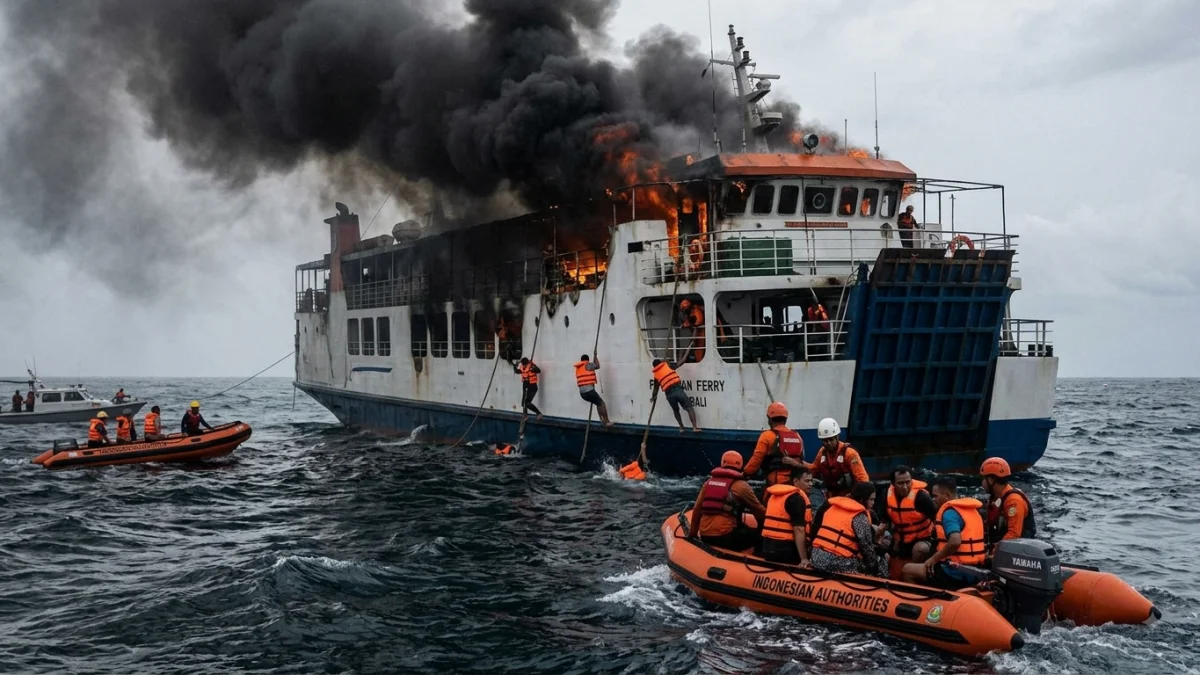


Thick smoke rose from the KM Putri Yasmin in the Lombok Strait early on Wednesday as passengers fled a ferry that had been carrying them from Bali toward Lombok, turning a routine crossing between two of Indonesia’s most traveled islands into a large-scale sea rescue.
The ferry left Padangbai port in Bali’s Karangasem regency at about 1:55 a.m., bound for Lembar port in West Nusa Tenggara. Less than three hours later, at about 4:39 a.m., a fire was reported aboard the vessel, according to Muhammad Hariyadi, head of the local search and rescue agency.


By Wednesday afternoon, rescuers had evacuated at least 172 people, while one Indonesian passenger had died. Authorities were still working to establish whether anyone else was missing. More than 200 personnel took part in the response, with rescue boats and other vessels converging on the burning ferry.
For those on board, the immediate problem was not simply the fire. It was reaching safety from a vessel surrounded by open water.
Images released through Indonesia’s National Search and Rescue Agency showed passengers in the sea during the operation, while rescue craft moved among them. Other vessels in the area helped take people away from the stricken ferry.
The rescue effort included KN SAR 220 Mataram, KMP Portlink II, KAL Lembar, police boats and private yachts, according to reporting by The Australian. Some evacuees were taken directly aboard larger rescue vessels, while smaller craft and yachts helped retrieve people from the water.
Among those rescued were Australians Aaliyah Bree Tepaea Such, 20, and Scoot Jeremi, 55, according to local rescue officials cited by The Australian. Several injured passengers were taken to hospital on stretchers.
The death of 19-year-old Ananda Indah Dwi Septiani brought a fatal dimension to an evacuation that otherwise prevented what could have been a much larger disaster. Authorities identified her as the daughter of a local police officer, according to The Australian.
The precise circumstances of her death, and the cause of the fire itself, remained unclear.
So too did the exact number of people who had been aboard.
An early manifest recorded 114 passengers and 17 crew members, according to Heri Wiyanto, an official at Padangbai port who spoke to Indonesian broadcaster Kompas TV. Yet rescuers later reported evacuating 172 people. Other local reporting put the number rescued at 173.
That discrepancy is significant because passenger manifests are a basic tool of maritime safety: in an emergency, rescuers need to know how many people may be aboard and who remains unaccounted for.
Officials have not said that overcrowding caused Wednesday’s fire. Reuters reported that it remained unclear whether overcrowding was a factor, and the cause of the blaze had not been established.
But the uncertainty over the passenger count has immediately placed the incident within a wider debate about ferry safety in Indonesia, an archipelago of about 17,000 islands where sea transport is indispensable for millions of people.
Ferries connect communities that cannot easily be reached by road or air. They carry workers, families, tourists, vehicles and goods between islands, often providing a cheaper and more accessible alternative to flying. That dependence means that a maritime accident is rarely only a story about a single vessel.
Wednesday’s fire came less than a month after another Indonesian ferry disaster. The KM Mutiara Sentosa 2 caught fire off Madura island earlier in August, killing five people. That vessel, too, was reported to have been carrying more people than appeared on its manifest.
The repeated incidents have renewed questions about how safety rules are enforced across Indonesia’s vast maritime network. Reuters reported that safety standards are not always rigorously enforced, contributing to the country’s relatively high rate of maritime accidents.
Yet on Wednesday, the immediate story was one of evacuation rather than investigation.
Rescuers coordinated multiple vessels around the burning ferry, while passengers were moved away from danger and brought toward ports on Bali and Lombok. The presence of several nearby boats gave rescue teams multiple ways to reach people in the water.
For the survivors, the journey that began before dawn between two neighboring islands ended not at Lembar port as planned, but aboard rescue vessels and at hospitals and ports on either side of the strait.
The sea crossing was supposed to be one of Indonesia’s ordinary journeys: a ferry leaving Bali in the early hours, carrying people and vehicles toward Lombok. Instead, the Putri Yasmin became the center of a rescue operation that stretched across the water, leaving one passenger dead, dozens of people pulled from danger and officials still seeking a definitive account of how the fire began and exactly how many people had been aboard.
Those unanswered questions now sit alongside the central fact of the morning: hundreds of lives were at risk on a burning ferry, and a fleet of rescuers reached them before the disaster became far larger.