

Colombian rescuers were still searching through collapsed buildings on Tuesday when another survivor was brought into the open in Cali, offering a brief reprieve from a disaster that had already killed hundreds and left thousands of people unaccounted for.
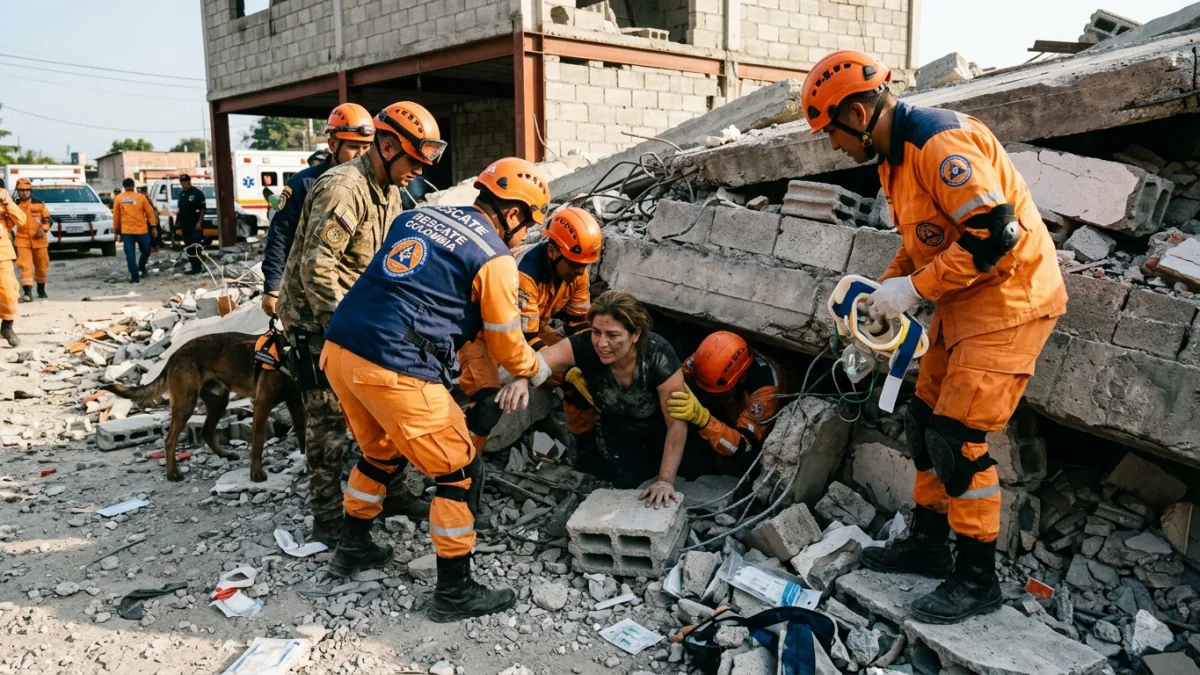
The woman, identified by local media as 31-year-old Diana Troncoso, was rescued by firefighters after a 16-hour operation at a collapsed building, according to reporting from The Guardian. Her father, Álvaro Troncoso Torres, watched nearby and described her emergence as a miracle.


Her rescue came as emergency crews across western Colombia worked through the critical first days after a magnitude 7.4 earthquake struck on Monday morning. The quake was centered in the country's western region and caused widespread destruction in Cali, Pereira, Manizales and other communities.
For rescuers, each confirmed sign of life carried significance beyond a single building. Firefighters in Cali had already pulled a 35-year-old man from the wreckage shortly before 4 a.m. on Tuesday, almost 24 hours after the earthquake struck. The city's fire department said the discovery demonstrated that people could still be alive beneath the debris.
"We have found life under the debris ... Every minute counts," the department said in a post accompanying video of the rescue.
The rescue of Troncoso followed the same race against time. According to The Guardian, firefighters spent 16 hours working to reach her before she was brought out on Tuesday afternoon. Applause broke out after she was freed, as emergency crews continued their search around the ruined structure.
The moments of survival unfolded against a rapidly expanding toll. Reports on Tuesday put the number of dead at more than 200, while thousands of people remained missing or unaccounted for. The earthquake also damaged or destroyed hundreds of buildings, leaving hospitals, emergency services and local authorities confronting an enormous logistical challenge.
Cali, one of the hardest-hit cities, became a center of the rescue effort. Emergency responders said they had rescued dozens of people from collapsed buildings, while teams used search dogs, specialized equipment and controlled removal of debris to reach spaces where survivors might remain.
The work was dangerous. Collapsed structures can shift without warning, and rescuers must balance speed against the possibility that moving one section of concrete could bring down another. The task becomes even more difficult as the hours pass and rescuers confront fatigue, damaged infrastructure and uncertainty over where people may be trapped.
Colombia's search-and-rescue teams had recently undergone an international evaluation under the United Nations' International Search and Rescue Advisory Group system. In June, Colombia's national disaster agency said its USAR COL-1 team had retained one of the world's most demanding international certifications after 36 hours of continuous evaluation involving 62 specialists and four search dogs.
That preparation was now being tested at home.
The earthquake struck at about 7:34 a.m. on Monday, according to reporting from The Guardian. It was described as Colombia's deadliest earthquake in decades, recalling the devastating 1999 earthquake in the coffee-growing region that killed more than 1,000 people.
The disaster also came only days after President Abelardo de la Espriella took office. His government declared an emergency and mobilized soldiers and ministers to affected areas as authorities sought to coordinate rescue operations and maintain order.
But amid the political response and rising casualty figures, the rescue teams remained focused on the immediate question beneath each collapsed structure: whether someone was still alive.
The answer in Troncoso's case came after hours of painstaking work. Her father told journalists that getting out of the wreckage was "a miracle," a simple description of what the rescue meant to her family after hours of uncertainty.
Other families were still waiting.
In Pereira, north of Cali, dozens of people were reported trapped in collapsed buildings, while hospitals struggled with the influx of injured residents. Across the affected region, rescue crews continued to search structures where survivors might still be found.
The rescues did not erase the scale of the destruction. They did, however, provide a reason for emergency workers to continue digging as the window for finding survivors narrowed.
For the families gathered near damaged buildings, the search remained intensely personal. Every movement of machinery, every call from a rescuer and every indication of life beneath the concrete could change the outcome.
In the aftermath of a disaster measured in deaths, missing people and collapsed buildings, the rescue of one woman offered a smaller measure of what the search teams were fighting to preserve: the possibility that beneath the rubble, the story was not yet over.