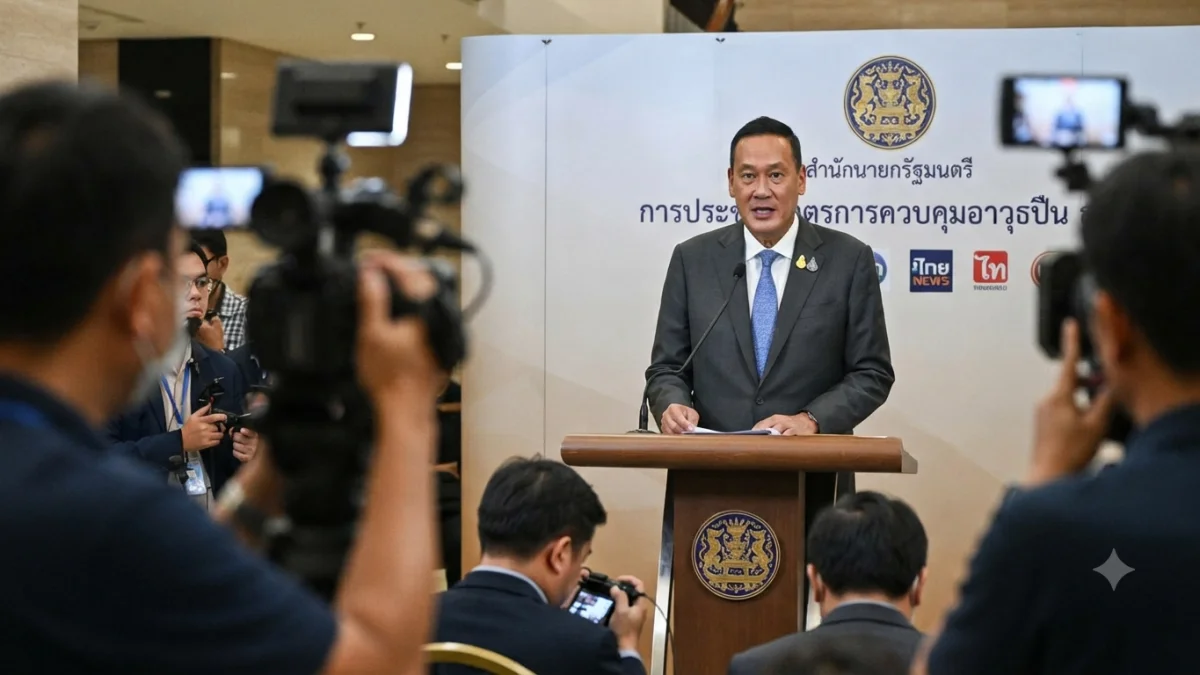


Thailand’s prime minister has pledged a new firearms control law after a 14-year-old student used his grandfather’s handgun in a shooting rampage that killed eight people, including himself, near Bangkok, putting renewed pressure on a government that had already tightened gun controls earlier this year.
Prime Minister Anutin Charnvirakul said the proposed legislation would restrict the carrying of firearms in public to government officials who are on duty. He gave no further details, including whether the government intends to tighten rules governing firearm ownership itself. The distinction matters because Thailand operates separate licensing systems for owning and carrying guns, meaning a tighter carry regime would not necessarily address how firearms already held legally in private homes are secured.


The Aug. 7 attack illustrates that challenge. Police said the teenager first killed his grandparents and then went to Debsirin Nonthaburi School, where he killed five teachers and staff before shooting himself. The weapon belonged to his grandfather, and police said the teenager fired at least 26 rounds and that additional ammunition was recovered. Twenty-three people were wounded, according to police.
That sequence places firearm access and household storage at the center of the policy debate. A law focused primarily on carrying guns in public would address one part of Thailand’s firearms system, but the circumstances of the shooting raise a separate question: how effectively can authorities prevent a licensed firearm from being accessed by someone who is not legally entitled to possess it?
Thailand has a substantial civilian firearms stock. A 2017 estimate by the Small Arms Survey put the number of civilian firearms at about 10.3 million, or roughly 15 guns per 100 people, the highest rate in Southeast Asia. More than 6 million were estimated to be registered, while about 4 million were unregistered. Because those figures are estimates from 2017 rather than a current national firearms census, they provide an indication of the scale of the issue rather than a precise measure of the weapons currently in circulation.
The latest pledge also builds on measures already taken under Anutin. After a 2023 shooting at a Bangkok shopping mall, when he was interior minister, authorities introduced temporary restrictions on new gun licences, tightened import controls and prohibited people under 20 from using shooting ranges. Longer-term proposals included medical certification covering the mental and psychological condition of gun owners and fixed validity periods for some licences.
In February, the government again tightened enforcement. Anutin signed an order temporarily suspending the issuance of licences to carry firearms in public for one year, while authorities were instructed to apply stricter scrutiny to firearm purchase applications and monitor existing licence holders. The government said the measures were intended to improve public safety and reduce gun-related crime.
The renewed debate therefore concerns not simply whether Thailand has gun regulations, but whether its existing system can identify and manage risk before a firearm is used. Piyaporn Tunneekul, an associate professor at Nakhon Pathom Rajabhat University, told Reuters that Thailand's licensing system does not currently include mental-health screening for applicants, permits firearm ownership from age 20 and does not require periodic reassessment of licence holders. She argued that reforms could include mechanisms similar to so-called red-flag laws used elsewhere, under which firearms can be removed when authorities determine that a person presents a risk to themselves or others.
The latest shooting also carries historical weight because it follows some of Thailand’s deadliest recent attacks. In 2022, a former police officer killed 36 people, including 22 children, at a childcare centre in northeastern Thailand before killing family members and himself. Other shootings have struck a Bangkok shopping mall and schools, reinforcing concerns about the availability and control of firearms beyond conventional criminal activity.
For the government, the immediate policy challenge is converting a broad pledge into enforceable rules. Restricting public carry could reduce the circumstances in which legally owned guns are brought into public places, while tighter licensing, secure-storage requirements, reassessment procedures and controls on access within households would address different points in the chain. The effectiveness of any reform will ultimately depend not only on legislation but also on licensing administration, police enforcement and the government's ability to account for both registered and unregistered weapons.
The confirmed situation is that Anutin has committed to new firearms legislation following the Aug. 7 attack, but the government has not yet published the proposed law or specified its full ownership, licensing or storage provisions. Authorities continue to investigate the shooting, while the scope and timetable of the promised reforms remain to be established.