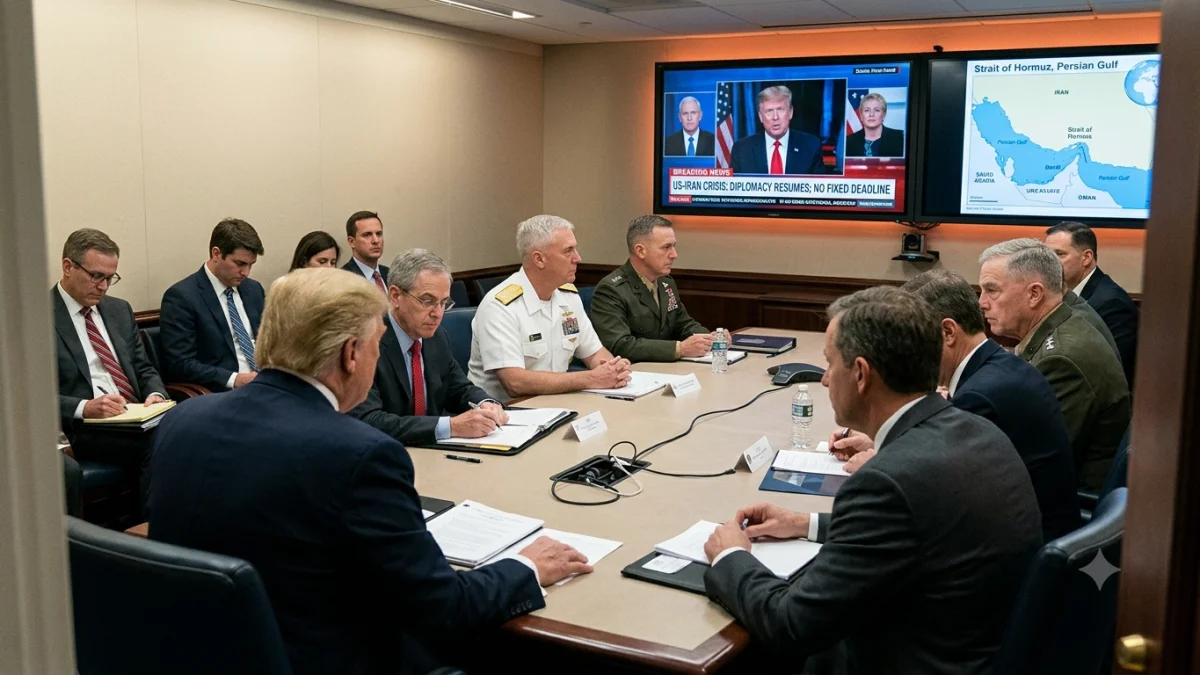


President Donald Trump's decision to halt planned U.S. military strikes against Iran while allowing negotiations to resume without setting a fixed deadline marks another shift from coercive pressure toward conditional diplomacy in one of the Middle East's most volatile crises. The announcement follows months of military confrontation and repeated cycles of escalation and de-escalation that have placed regional security, global energy markets and international diplomacy under sustained strain.
The significance of the latest move lies less in the immediate suspension of military action than in Washington's willingness to preserve negotiating space despite the absence of a formal timetable. By declining to impose a deadline for a potential agreement, the Trump administration has reduced one source of immediate pressure that previously raised concerns about a rapid return to hostilities. At the same time, U.S. officials have continued to indicate that the military option remains available should diplomacy fail, underscoring that the pause represents a tactical adjustment rather than a broader strategic settlement.


According to President Trump, negotiations are scheduled to resume through intermediaries, although he has provided few details regarding participants or venue. The administration has linked the diplomatic effort to two principal objectives: addressing concerns surrounding Iran's nuclear activities and restoring maritime stability around the Strait of Hormuz, one of the world's most important energy transit routes. Reuters has reported that regional intermediaries, including Oman, continue to play a central role in facilitating contacts, while Gulf states have encouraged efforts to avoid renewed conflict.
The absence of a fixed deadline also reflects the complexity of the negotiations themselves. Diplomatic efforts involve multiple interconnected issues extending beyond Iran's nuclear programme, including regional security arrangements, freedom of navigation through the Strait of Hormuz and mechanisms intended to reduce the risk of renewed military confrontation. Each issue involves different stakeholders whose interests do not always align, making rapid agreement difficult even if both Washington and Tehran remain engaged.
The diplomatic opening follows months of repeated reversals between military action and negotiations. Since the conflict intensified earlier in 2026, President Trump has announced several pauses in military operations before warning that strikes could resume if talks failed to produce sufficient progress. That pattern has created uncertainty among allies, markets and regional governments attempting to assess whether each diplomatic initiative represents a durable policy shift or a temporary interruption in military operations.
Iran, meanwhile, has continued to deny seeking nuclear weapons while maintaining that its security interests must be respected. Public statements from Tehran have at times differed from Washington's characterization of ongoing diplomacy, illustrating the persistent gap between the two governments' public messaging. Such differences do not necessarily preclude negotiations but demonstrate the political constraints facing both sides as they seek to balance domestic expectations with diplomatic flexibility.
The regional implications extend beyond bilateral U.S.-Iran relations. Israel has maintained that it reserves the right to act independently against Iranian nuclear or missile developments if it judges diplomacy insufficient. At the same time, Gulf Arab governments have generally supported efforts to reduce military escalation because prolonged conflict threatens shipping, investment and broader regional economic stability. Reuters has reported that Trump and Israeli Prime Minister Benjamin Netanyahu recently reviewed strategic options concerning Iran while parallel diplomatic contacts continued elsewhere in the region.
Financial markets responded quickly to the latest diplomatic signals. Oil prices declined sharply after the announcement that planned strikes had been suspended, reversing part of the substantial gains recorded during earlier phases of the crisis. Equity markets in Europe and U.S. stock futures also strengthened as investors interpreted the diplomatic pause as reducing the immediate risk of disruption to energy supplies moving through the Strait of Hormuz. Nevertheless, analysts cautioned that market sentiment remains highly sensitive because negotiations have yet to produce a lasting agreement and security risks in the region persist.
From a broader foreign policy perspective, the administration's approach illustrates the continued integration of military pressure and diplomacy rather than a clear choice between them. By preserving the possibility of renewed strikes while extending negotiations without a formal deadline, Washington appears to be attempting to maximize leverage without foreclosing diplomatic opportunities. Whether that balance strengthens negotiations or prolongs uncertainty remains a matter of differing assessment among analysts, but officials have consistently framed military restraint as contingent upon continued diplomatic progress rather than as an end in itself.
For now, the confirmed situation is that planned U.S. strikes have been suspended, negotiations are expected to proceed without a publicly defined deadline, and regional diplomacy continues through intermediary channels. Officials are closely monitoring whether talks produce measurable progress on nuclear issues, maritime security and broader de-escalation, while military options remain publicly available should negotiations fail to advance.