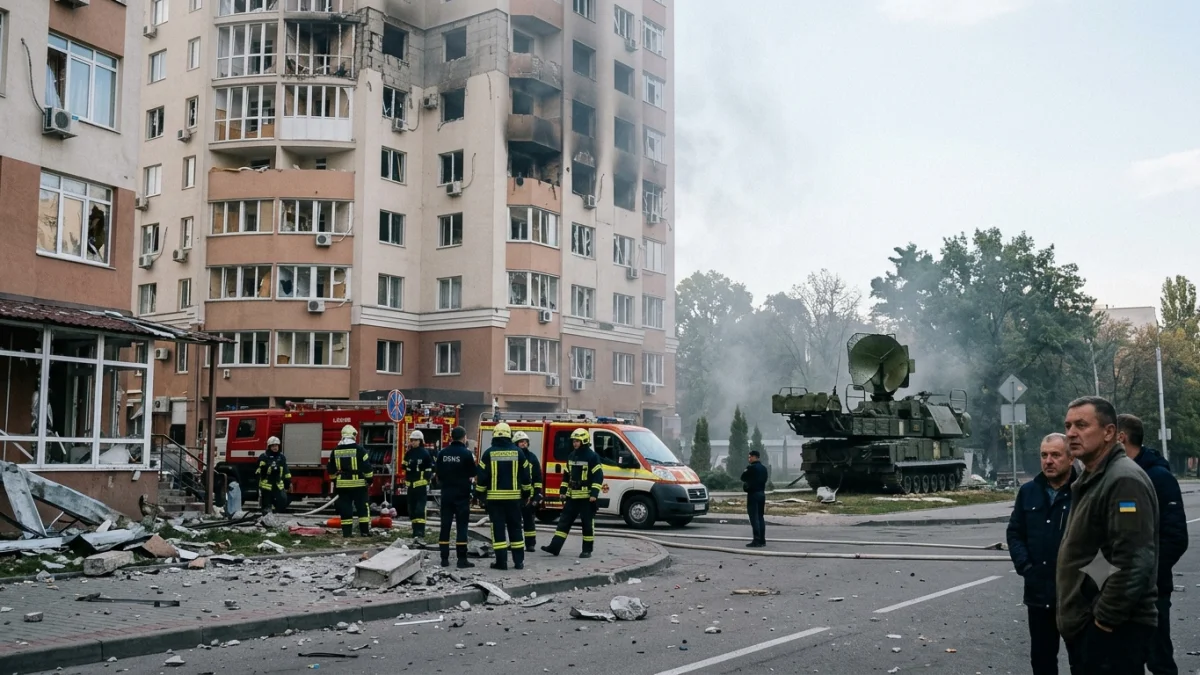


Ukraine’s worsening shortage of advanced air-defense interceptors has become a defining factor in Russia’s latest wave of missile attacks on Kyiv, exposing a growing vulnerability that is reshaping both the military balance around the capital and the broader strategic debate over Western security assistance. The latest Russian overnight assault, which Ukrainian officials said killed at least 17 people and injured dozens, highlighted how Moscow is increasingly combining ballistic missiles with large drone barrages at a time when Kyiv says it lacks sufficient interceptor stocks to counter the most difficult threats.
The significance of the latest strikes extends beyond the immediate casualties and infrastructure damage. Ukrainian authorities reported that while air defenses intercepted most of the drones launched during the attack, they were unable to destroy any of the ballistic missiles, underscoring the distinction between defending against slower unmanned aircraft and intercepting high-speed ballistic weapons. President Volodymyr Zelenskyy argued that additional anti-ballistic systems and interceptors could have reduced the human toll, renewing appeals for faster deliveries from international partners.


The attacks also illustrate an important evolution in Russia’s air campaign. Since the start of the full-scale invasion in 2022, Moscow has repeatedly combined missiles and drones to stretch Ukrainian defenses. More recently, however, Ukrainian military officials and independent analysts have pointed to a greater emphasis on ballistic missiles, reflecting an assessment that Kyiv’s limited stocks of Patriot interceptors and other advanced systems create opportunities to penetrate defenses protecting major cities and critical infrastructure. Reuters previously reported that Ukraine’s inability to intercept ballistic missiles during earlier large-scale attacks reflected dwindling interceptor inventories rather than broader failures of its air-defense network.
Ukraine’s Air Force has acknowledged that missile supplies remain under severe pressure after successive Russian attack campaigns. Air Force spokesperson Yuriy Ihnat said earlier this year that launchers assigned to some air-defense batteries were only partially stocked and that Ukraine had been forced to seek small emergency resupplies of missiles for systems such as NASAMS and IRIS-T. Although Ukraine has expanded the use of electronic warfare, mobile fire groups and domestically developed interceptor drones against long-range drones, officials have emphasized that ballistic missile defense continues to depend heavily on foreign-supplied systems.
For Russia, the campaign reflects an effort to exploit both technological and logistical realities. Ballistic missiles travel at speeds and trajectories that make them substantially harder to intercept than cruise missiles or drones. If intelligence assessments indicate declining interceptor stocks, increasing the proportion of ballistic weapons can improve the likelihood that some missiles reach their intended targets. The latest attacks reportedly struck warehouses, logistics facilities and transport infrastructure, which Russia described as military-related objectives, while Ukrainian officials said civilian infrastructure sustained significant damage.
The challenge extends beyond the battlefield. Ukraine’s dependence on Western-produced interceptors has increasingly become a strategic issue for allied governments balancing competing security demands. Reuters has reported that Ukraine experienced earlier shortages affecting F-16 air-to-air missiles and has repeatedly warned of constrained supplies as demand for advanced air-defense munitions has grown globally. Those pressures have coincided with broader geopolitical tensions that have increased demand for similar systems in other regions, complicating production schedules and delivery timelines.
Military analysts generally caution that air defense is measured not only by the number of launchers deployed but also by the sustainability of interceptor inventories. Even sophisticated systems become less effective if missile stocks cannot be replenished at the pace required by prolonged high-intensity attacks. The repeated need to prioritize protection of key population centers, government institutions and critical infrastructure means commanders face increasingly difficult decisions about where limited interceptors should be allocated.
Another emerging concern is the reported expansion of Russia’s access to foreign-supplied weapons. Ukrainian military intelligence said this week that North Korea had deployed a missile unit to Russia equipped with ballistic missile systems, deepening military cooperation between Moscow and Pyongyang. Although Reuters could not independently verify every aspect of Kyiv’s assessment, the reported deployment reflects broader concerns that Russia may be able to sustain or expand ballistic missile operations even as the war enters another prolonged phase.
The latest attacks therefore reinforce a broader pattern visible over recent months: Russia appears increasingly focused on exploiting identified weaknesses in Ukraine’s defensive architecture, while Ukraine continues to adapt through improved drone interception, electronic warfare and domestic innovation where possible. Those measures have reduced the effectiveness of many drone attacks but have not eliminated dependence on advanced Western systems for ballistic missile defense.
As of Aug. 5, the confirmed picture is that Russia has intensified combined missile and drone strikes against Kyiv while Ukrainian officials continue to warn of critical shortages of anti-ballistic interceptors. Western governments remain under pressure to accelerate deliveries of air-defense equipment, while Russia maintains that it is targeting military-related infrastructure. Whether additional interceptor supplies, expanded production or further military assistance can narrow Ukraine’s defensive gap remains a central issue being monitored by Kyiv, its international partners and independent defense analysts.