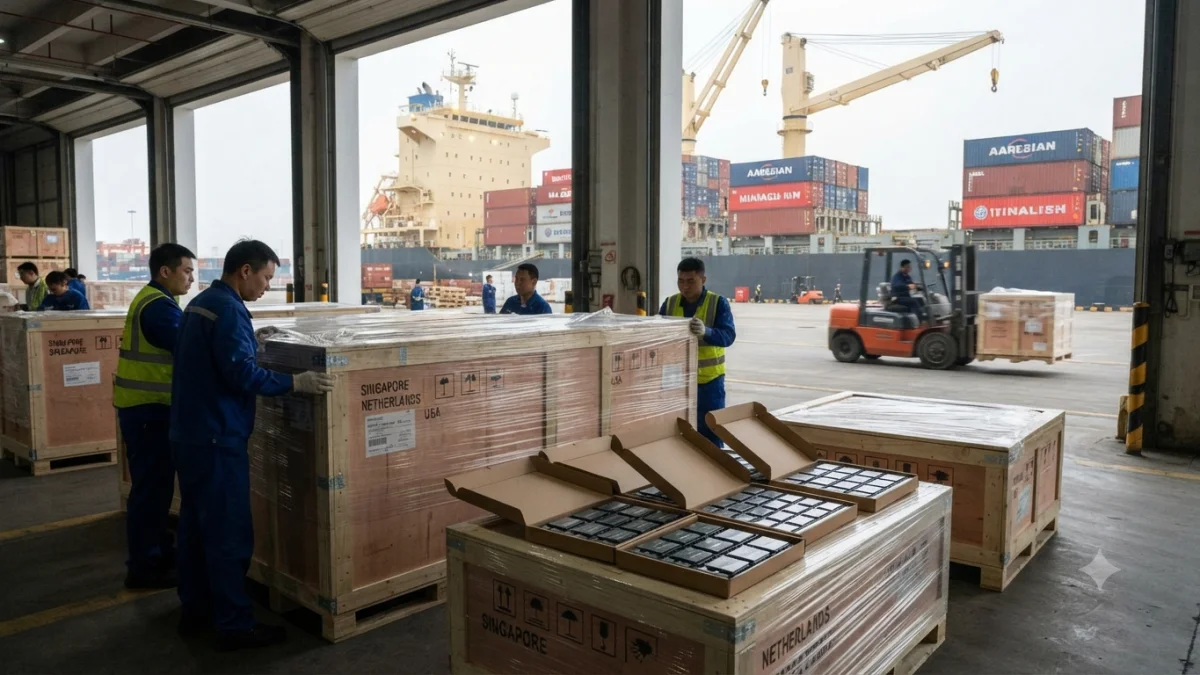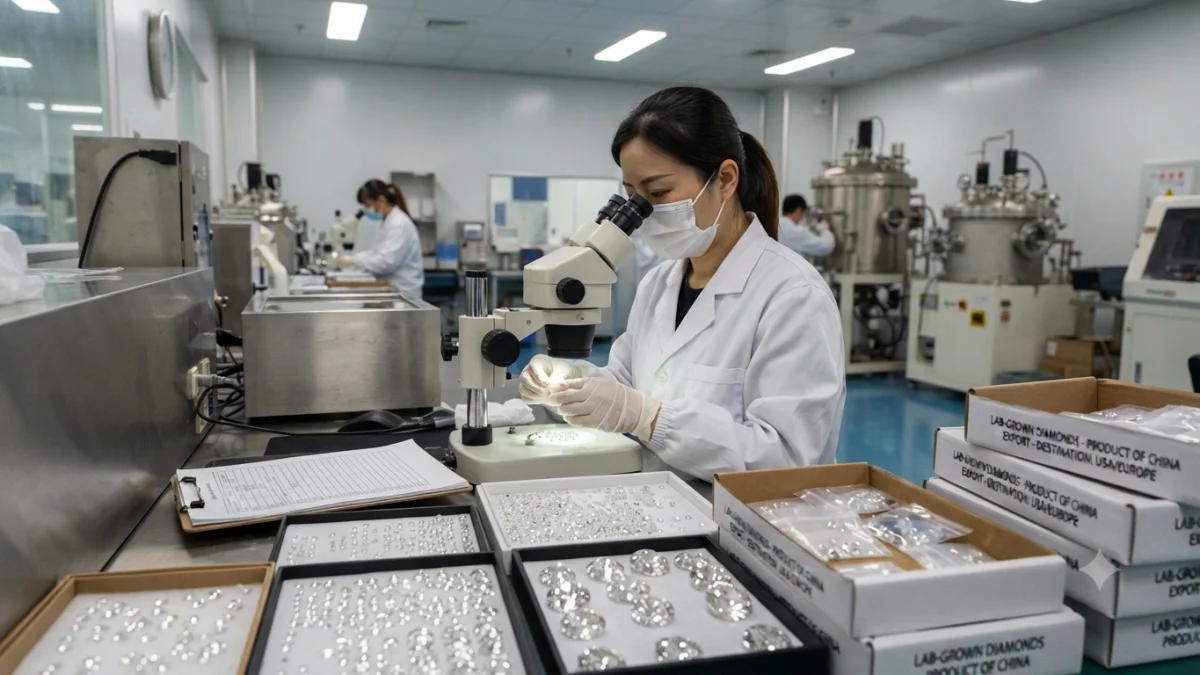


SHANGHAI — China’s exports of laboratory-grown diamond rough surged in May, as rising demand for diamond-based materials used in advanced electronics and artificial-intelligence infrastructure added a new growth driver to the country’s synthetic diamond industry.
China exported about 4.44 million carats of laboratory-grown diamond rough in May, worth approximately $32.6 million, according to Chinese customs data cited by industry sources. Export volume rose 135.87% from a year earlier, while export value increased 101.36%. For the first five months of 2026, exports reached about 17.93 million carats, valued at roughly $159 million, up 44.40% in volume and 62.43% in value, the data showed.


The increase comes as Chinese producers seek to expand beyond the jewelry market into industrial applications, including thermal management for high-performance chips. Diamond has exceptionally high thermal conductivity, making it a potential material for dissipating heat from increasingly powerful processors used in AI computing.
China Daily reported last month that the AI boom was providing a new growth path for the country's synthetic diamond industry. Sui Dong, a researcher at private market tracker Simuwang, said the sector's growth was shifting from consumer demand toward advanced materials and the increasing value of AI computing capacity.
Chinese companies are already investing in the technology. Henan-based Huifeng Diamond has been developing high-pressure high-temperature and chemical-vapor-deposition technologies for diamond thermal-management applications. The company began production at a new chemical-vapor-deposition project in Inner Mongolia in July, according to China Daily.
Liliang Diamond, another Chinese producer, said in June that it planned to redirect 1.028 billion yuan ($142 million) of previously raised funds from expanding its laboratory-grown diamond factory toward synthetic-diamond functional materials, including applications in AI-chip thermal management, optical materials and acoustic components.
The shift reflects a broader effort by Chinese producers to diversify as the jewelry market faces falling prices and intense competition. Laboratory-grown diamonds are manufactured using processes including HPHT and CVD, while the same material properties that make them suitable for jewelry also allow their use in industrial and electronic applications.
China remains the dominant producer of synthetic diamonds, according to a recent academic study of the country's industry, which found that production expanded more than 15-fold between 1999 and 2022 and increasingly moved toward higher-value applications.
The latest customs figures indicate that export growth is already accelerating, while Chinese companies continue developing industrial applications that could determine the sector's next phase of expansion.