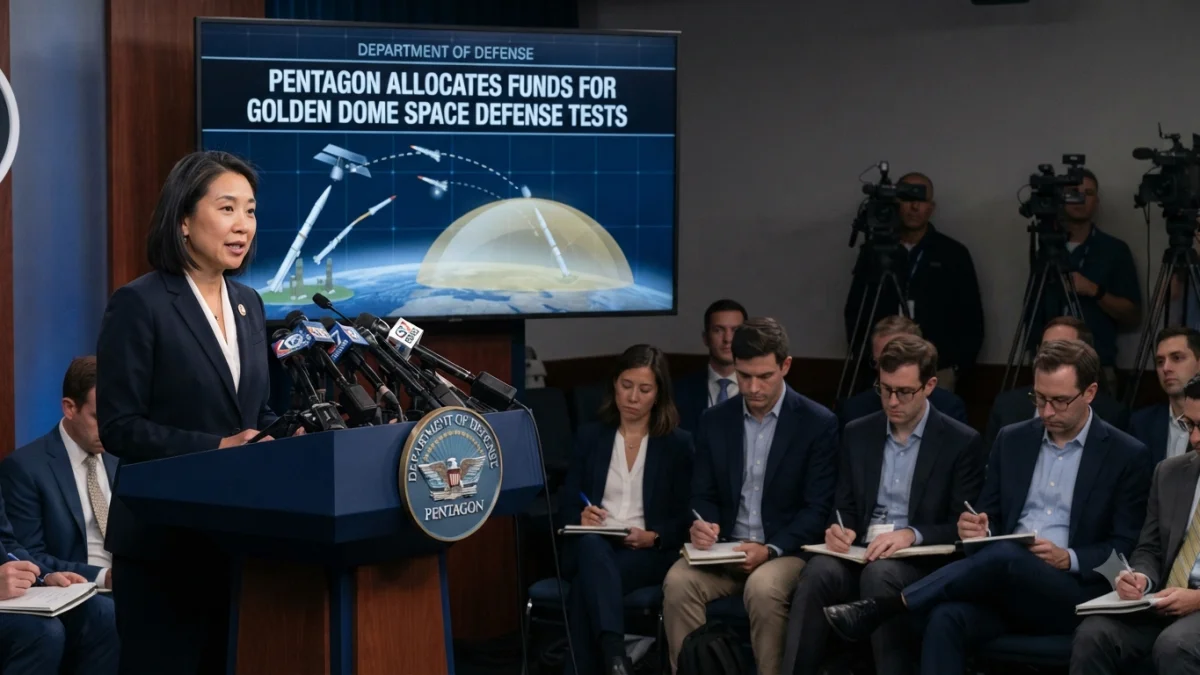


WASHINGTON — The Pentagon is moving ahead with plans to test space-based missile interceptors for President Donald Trump’s Golden Dome missile-defense program, with initial testing expected before the end of 2026 and orbital demonstrations planned for 2027, according to reporting on the program.
The effort is backed by a broader prototype program worth up to $3.2 billion and is intended to determine whether weapons positioned in low-Earth orbit can intercept missiles during different phases of flight. The U.S. Space Force’s Space Systems Command awarded 20 agreements to 12 companies for the development of competing space-based interceptor technologies in late 2025 and early 2026.


The companies include Lockheed Martin, Northrop Grumman, Raytheon, General Dynamics, SpaceX, Anduril Industries, Booz Allen Hamilton, True Anomaly, Turion Space, Quindar, GITAI USA and SciTec. The Space Force has said the prototypes are intended to support an initial integrated capability within the Golden Dome architecture by 2028.
The space-based interceptor layer is designed to complement missile-warning and tracking satellites, ground-based sensors and existing interceptors. The Space Development Agency separately awarded about $1.75 billion in July for 36 additional satellites intended to strengthen missile warning, tracking and defense capabilities in support of Golden Dome.
The Pentagon has not publicly disclosed detailed testing plans or technical specifications for the interceptor systems, citing operational security considerations. The program remains at the prototype and demonstration stage rather than being an operational weapons system.
The effort also faces questions over whether space-based interceptors can be produced and deployed at sufficient scale and cost. Gen. Michael Guetlein, who leads the Golden Dome program, told lawmakers in April that the government still needed to determine whether the technology could be built affordably at scale.
Cost estimates for the wider Golden Dome initiative vary substantially. The Pentagon has put its initial program estimate at about $185 billion, while the Congressional Budget Office estimated in May that acquisition and operation over 20 years could total roughly $1.2 trillion, depending on the architecture ultimately adopted.
Northrop Grumman has said it completed ground tests in 2026 and plans an on-orbit demonstration in 2027 with satellite maker Apex, adding another privately supported test effort to the broader government-backed development campaign.
The Pentagon’s next major milestone is the planned testing and demonstration campaign, which will determine whether the competing space-based interceptor concepts can advance toward integration into Golden Dome.