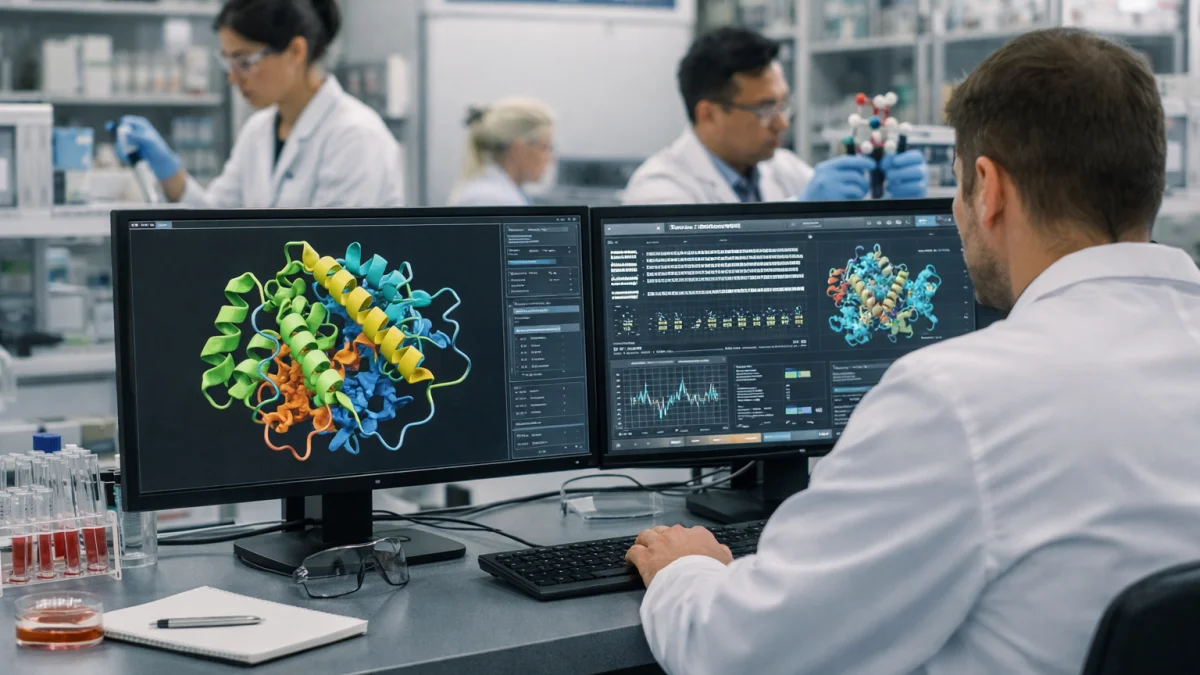


LONDON — Artificial intelligence systems that predict the three-dimensional structures of proteins are continuing to reshape early-stage drug discovery, with new databases and modeling tools expanding scientists' ability to identify potential therapeutic targets and design experimental medicines, according to researchers and public institutions.
The latest advances build on earlier breakthroughs in AI-based protein structure prediction by extending models beyond individual proteins to include protein complexes and a substantially larger catalog of predicted biological structures. Scientists say the expanded resources could help researchers better understand how proteins interact in health and disease, potentially accelerating the search for new drug candidates while reducing reliance on time-consuming laboratory experiments.


In May, researchers at the Chan Zuckerberg Initiative's Biohub unveiled an updated open-source ESM Atlas generated by its ESMFold2 model, containing more than one billion predicted protein structures and billions of protein sequences. According to the project, the expanded atlas significantly enlarges the publicly available collection of AI-predicted protein structures for biological research.
Separately, a collaboration involving EMBL's European Bioinformatics Institute, Google DeepMind, NVIDIA and Seoul National University has added millions of predicted protein complexes to the AlphaFold Database. The organizations said the release enables researchers to study not only individual protein structures but also how proteins interact with one another, an important consideration in understanding disease mechanisms and identifying drug targets.
Researchers caution, however, that AI-generated predictions complement rather than replace experimental methods such as X-ray crystallography, cryo-electron microscopy and nuclear magnetic resonance. While modern AI models can achieve near-experimental accuracy for many proteins, laboratory validation remains necessary before predicted structures can support drug development or regulatory submissions.
Scientific reviews published this year also point to growing interest in applying newer AI systems to predict protein conformational states, protein-protein interactions and protein-ligand binding, areas considered important for structure-based drug discovery. Experts note that challenges remain, including accurately modeling protein dynamics and rare biological states that influence how medicines work.
Investment in AI-driven drug discovery has continued alongside the scientific advances. In May, Isomorphic Labs, an Alphabet-backed company that uses AI technologies including AlphaFold-derived methods for drug design, announced a $2.1 billion funding round aimed at expanding its research platform and advancing experimental drug programs toward clinical testing.
Researchers say continued collaboration between AI developers, structural biologists and pharmaceutical companies will be essential as the field works to translate increasingly accurate computational predictions into experimentally validated therapies.