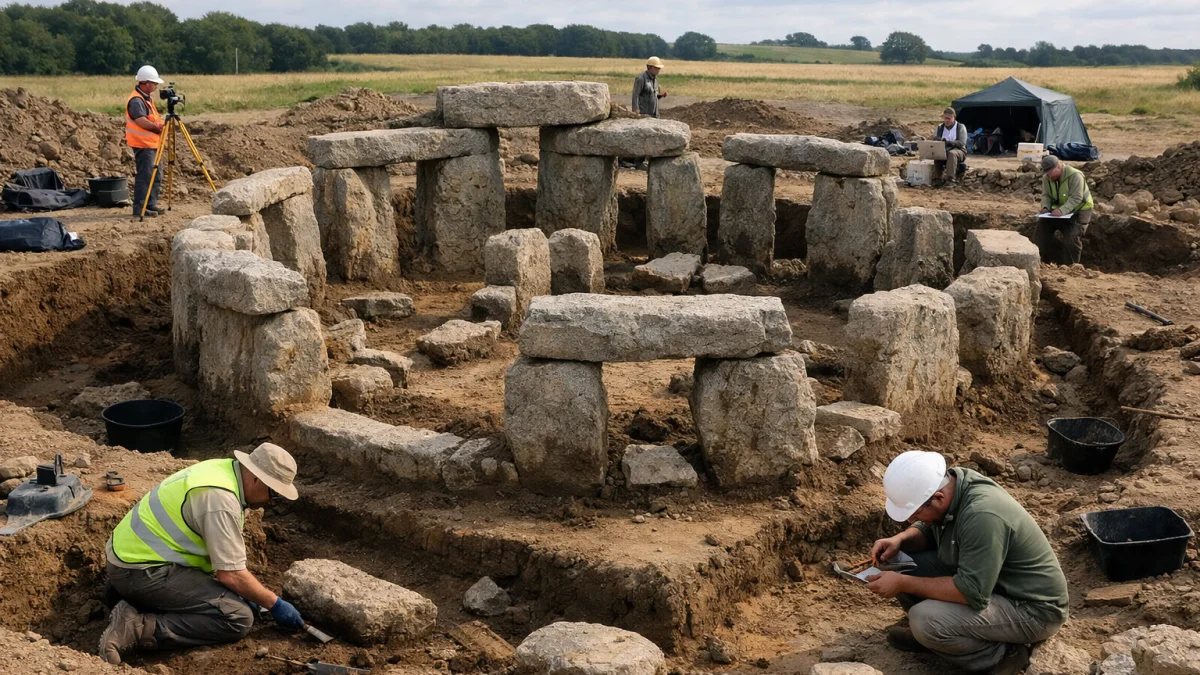


LONDON — Archaeologists have identified a prehistoric wooden monument near Stonehenge that they believe may have served as an early prototype for the world-famous Neolithic site, according to researchers who announced the discovery this week ahead of the summer solstice. The structure, found at Bulford in Wiltshire, southern England, is estimated to be about 5,000 years old and to predate Stonehenge’s main stone circle by roughly 500 years.
The discovery was made by a team from Wessex Archaeology led by archaeologist Phil Harding. Researchers said the monument originally consisted of two large wooden posts positioned about 120 meters (394 feet) apart and aligned with the summer solstice sunrise and winter solstice sunset, mirroring the astronomical orientation later associated with Stonehenge.


According to Wessex Archaeology, the site was excavated between 2015 and 2017 during archaeological work connected to a British Ministry of Defence housing project. Detailed analysis conducted in subsequent years enabled researchers to confirm the monument’s alignment with key solar events.
The site lies about 5 kilometers (3 miles) from Stonehenge and forms part of a wider prehistoric landscape that has long been regarded as an important ceremonial area. Archaeologists said excavations uncovered pottery, animal bones, flint tools and a rare disc-shaped flint knife, evidence they say suggests gatherings and ritual activity may have taken place there.
Researchers said radiocarbon dating indicates the monument dates to around 3000 B.C. or slightly earlier. Experts involved in the project believe the structure may represent one of the earliest known examples in the area of a monument deliberately aligned with the solstices.
“Opportunities like this probably only come once in a career, in a lifetime,” Harding said in comments released by the research team. He described the discovery as a major milestone in understanding the development of ceremonial traditions in prehistoric Britain.
Independent specialists who examined the site’s astronomical orientation said the alignment appears consistent with the position of the sun during the summer and winter solstices at the time the monument was constructed. Researchers said the finding could provide new evidence about how Neolithic communities observed seasonal cycles and organized ceremonial activities.
The findings were announced days before annual summer solstice gatherings at Stonehenge. Researchers said analysis of the Bulford site is continuing, and additional studies are expected to further examine its relationship to the broader Stonehenge landscape.