

China’s successful recovery of an orbital-class rocket booster marks a significant milestone in the country’s effort to develop reusable launch systems, narrowing a technological gap that has long separated it from the United States. The achievement places China among a small group of spacefaring nations capable of recovering launch vehicles intended for reuse, a capability widely viewed as essential for lowering launch costs, increasing launch frequency and supporting ambitious civil and commercial space programs.
The breakthrough is significant not because China has overtaken U.S. launch providers, but because it demonstrates that reusable launch technology is becoming an increasingly competitive global field rather than one dominated by a single country. For more than a decade, SpaceX transformed the economics of spaceflight by routinely recovering and reusing Falcon 9 boosters, while Blue Origin also demonstrated reusable launch capability through its own programs. China's latest success suggests that the engineering knowledge required for reusable orbital rockets is spreading, even though substantial differences remain in operational maturity and flight cadence.


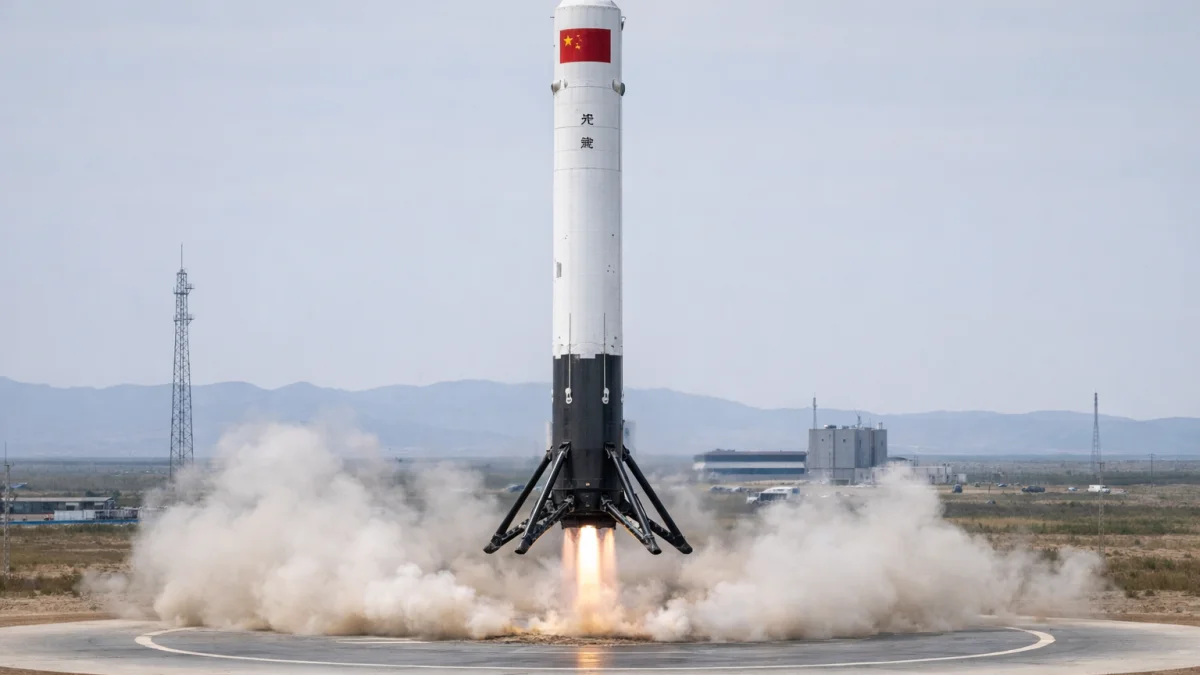
The latest mission involved the Long March-10B rocket, developed under the China Academy of Launch Vehicle Technology. After delivering its payload toward orbit from Hainan Island, the rocket's first stage performed a controlled return and was captured using a net suspended above a sea-based recovery platform. Unlike SpaceX's Falcon 9, which lands vertically on deployable legs, China's system relies on landing hooks that engage the recovery structure, reducing the need for heavy landing hardware and potentially preserving payload capacity. According to Chinese developers, the recovered booster is intended to fly again before the end of 2026, although that objective has yet to be demonstrated.
The importance of reusability lies primarily in economics. Conventional launch vehicles discard expensive first-stage boosters after every mission, requiring manufacturers to build new hardware for each launch. Reusable systems seek to recover, inspect and relaunch major components, reducing manufacturing costs and enabling more frequent missions. While refurbishment costs remain significant, repeated successful recoveries have enabled SpaceX to establish a launch tempo unmatched elsewhere, fundamentally changing commercial satellite deployment and government launch procurement.
China's achievement therefore represents progress toward broader strategic objectives rather than an isolated engineering demonstration. Beijing is expanding satellite constellations, supporting lunar exploration plans and increasing investment in commercial launch providers. Lower launch costs could strengthen those efforts by making more frequent missions economically viable while supporting domestic demand for communications, Earth observation and scientific spacecraft. State media and official statements have consistently linked reusable launch systems with China's long-term space infrastructure ambitions.
Nevertheless, important distinctions remain between achieving a first successful recovery and establishing an operationally reusable launch system. SpaceX has accumulated hundreds of successful booster recoveries and repeatedly flown individual boosters dozens of times, providing extensive operational data on refurbishment, reliability and maintenance cycles. China's Long March-10B has completed its first successful recovery, but repeated reflights under commercial operating conditions will be needed before similar economic benefits can be demonstrated.
The development also reflects broader changes within China's launch industry. Alongside state-owned programs, commercial companies such as LandSpace are pursuing reusable methane-fueled rockets designed to compete in the growing market for satellite constellation launches. Several Chinese firms have experienced unsuccessful recovery attempts in recent years, illustrating the technical complexity of precision booster landings. Continued experimentation across both state and commercial sectors suggests that reusable launch capability has become a national priority rather than a single-company initiative.
Internationally, the achievement highlights intensifying competition in space technology. Reusable launch vehicles increasingly underpin commercial launch markets, national security payloads and human spaceflight programs. Other countries, including Japan, are also pursuing reusable rocket technologies, reflecting an industry-wide recognition that launch cost reductions are becoming central to future space competitiveness. Rather than representing a symbolic race alone, advances in reusable launch systems influence satellite deployment capacity, scientific missions and the pace of broader space development.
The latest recovery also illustrates differing engineering philosophies. SpaceX emphasizes precision vertical landings on autonomous drone ships or landing pads using deployable landing legs, while China's sea-based net capture system seeks to eliminate some structural mass associated with conventional landing hardware. Whether the Chinese approach offers operational or economic advantages will depend on repeated successful recoveries, refurbishment requirements and long-term reliability, questions that remain unresolved.
China's first successful recovery of an orbital-class rocket booster therefore represents a verified technological milestone that narrows, but does not eliminate, the gap with established U.S. reusable launch capabilities. The immediate significance lies in demonstrating that China's reusable launch program has progressed beyond experimental concepts toward operational testing. The next developments being closely monitored include the planned reflight of the recovered Long March-10B booster, additional recovery demonstrations by Chinese launch providers, and whether repeated successful reuse can deliver the lower costs and higher launch cadence that have made reusable rockets transformative elsewhere.