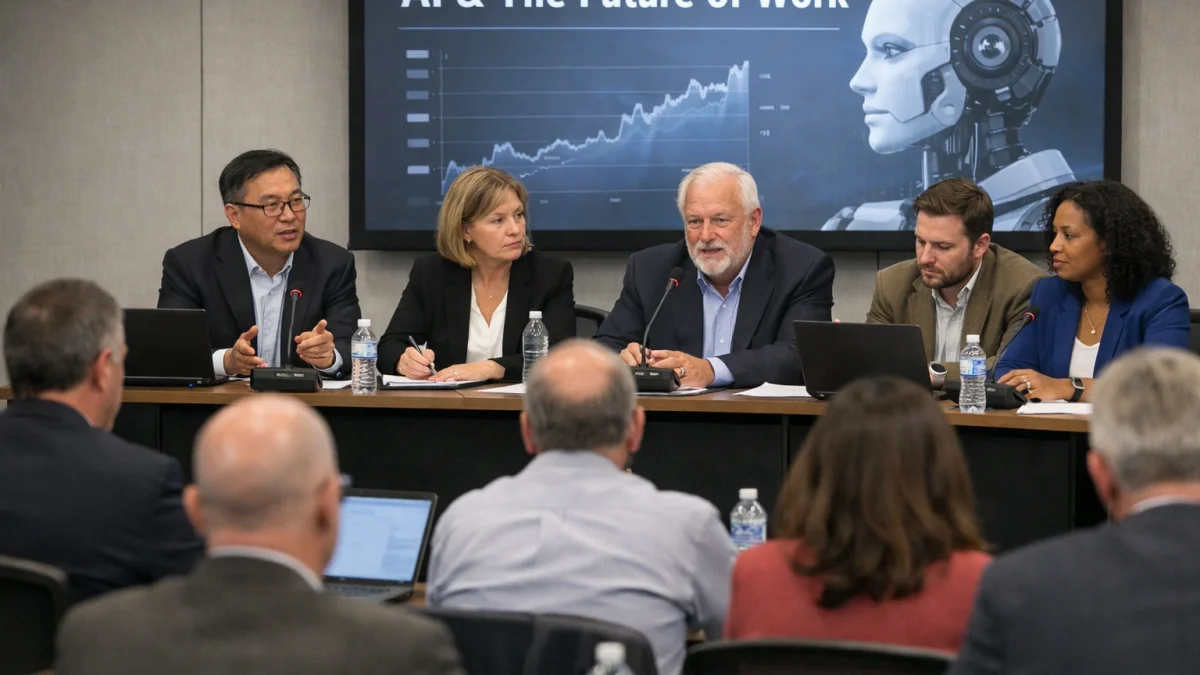


A broad coalition of economists, artificial intelligence researchers and technology leaders has issued one of the clearest cross-disciplinary warnings to date that governments and institutions should begin preparing now for AI-driven economic disruption rather than waiting for the effects to become unmistakable. The statement, released through Stanford University's Digital Economy Lab and signed by more than 200 experts, including 16 Nobel laureates, argues that increasingly capable AI systems could reshape the global economy on a scale exceeding the Industrial Revolution while unfolding over a far shorter period.
The significance of the initiative lies less in its brevity than in the unusual breadth of its support. Economists have often debated whether technological advances ultimately create as many jobs as they eliminate, while AI researchers have traditionally focused on technical capabilities and safety. The latest statement brings together both communities, alongside senior figures from companies developing frontier AI systems, around a common conclusion: policymakers should begin building institutions and economic frameworks before the technology's effects become fully visible rather than after labor markets have already adjusted.


The signatories stop short of predicting inevitable mass unemployment. Instead, they emphasize uncertainty while arguing that uncertainty itself justifies earlier preparation. Their statement notes that more powerful AI could generate substantial gains in productivity and living standards while simultaneously creating risks of large-scale job displacement. That framing reflects a growing consensus among many economists that the pace of technological change, rather than its direction alone, could challenge existing labor-market institutions.
The warning also represents a shift in the broader AI debate. Earlier discussions frequently centered on technical safety, misinformation, privacy or existential risks. Increasingly, economists are focusing on AI's macroeconomic consequences, including employment, income distribution, competition and productivity. Organizers of the statement—including economists Erik Brynjolfsson, Anton Korinek, Ajay Agrawal and Tom Cunningham—have argued that understanding these economic effects deserves the same urgency that governments devote to technological regulation or national competitiveness.
The composition of the signatories reinforces that message. Nobel Prize-winning economists joined AI researchers and senior figures from companies including OpenAI, Anthropic and Google. Their participation does not imply agreement on specific policies, but it does suggest growing recognition across academia and industry that AI's economic implications warrant systematic planning rather than ad hoc responses.
The intervention comes as evidence of AI's labor-market effects remains mixed. While businesses have accelerated investment in generative AI and AI-assisted software development, economists have yet to document widespread aggregate job losses directly attributable to the technology. At the same time, several recent studies have identified declining demand for some entry-level knowledge work, increased automation of routine cognitive tasks and organizational restructuring that enables smaller teams to perform work previously requiring larger staffs. These developments have intensified debate over whether AI will primarily augment workers or replace significant categories of employment.
Historical experience offers support for both interpretations. Previous technological revolutions, including mechanization and computerization, ultimately raised productivity and living standards while creating entirely new industries. However, those transitions often involved prolonged adjustment periods, regional disparities and displacement for workers whose skills became less valuable. Many economists argue that AI differs because software capable of performing complex cognitive tasks could spread globally within years instead of decades, compressing adjustment periods for businesses, workers and governments.
The policy questions raised by the statement therefore extend beyond employment alone. Researchers have highlighted issues including workforce retraining, education systems, competition policy, tax structures, social safety nets and incentives encouraging AI applications that complement rather than substitute for human labor. The statement itself deliberately avoids prescribing detailed legislative measures, instead calling for stronger research, institutional capacity and policy development before economic disruption accelerates.
Not all economists share the signatories' sense of urgency. Some analysts caution that forecasts about transformative AI remain highly uncertain and argue that governments should avoid designing policies around speculative scenarios. Others note that previous waves of automation generated fears of permanent technological unemployment that ultimately proved overstated. Critics also argue that premature regulation could slow innovation without delivering measurable economic benefits.
Nevertheless, the statement reflects a notable evolution in expert opinion. Rather than debating whether AI will affect the economy, the discussion is increasingly focused on how rapidly those effects could emerge and whether existing institutions are prepared to respond. The participation of economists, AI scientists and industry leaders in a common appeal suggests growing agreement that economic governance deserves greater attention alongside technical AI development.
For now, the statement does not signal a consensus on the scale of future disruption or on the specific policies governments should adopt. What is confirmed is that a large group of leading economists and AI researchers believes preparation should begin before clearer evidence of labor-market disruption emerges. Policymakers, researchers and technology companies are expected to continue monitoring AI deployment, employment trends, productivity data and emerging evidence on how increasingly capable AI systems affect workers, businesses and economic growth.