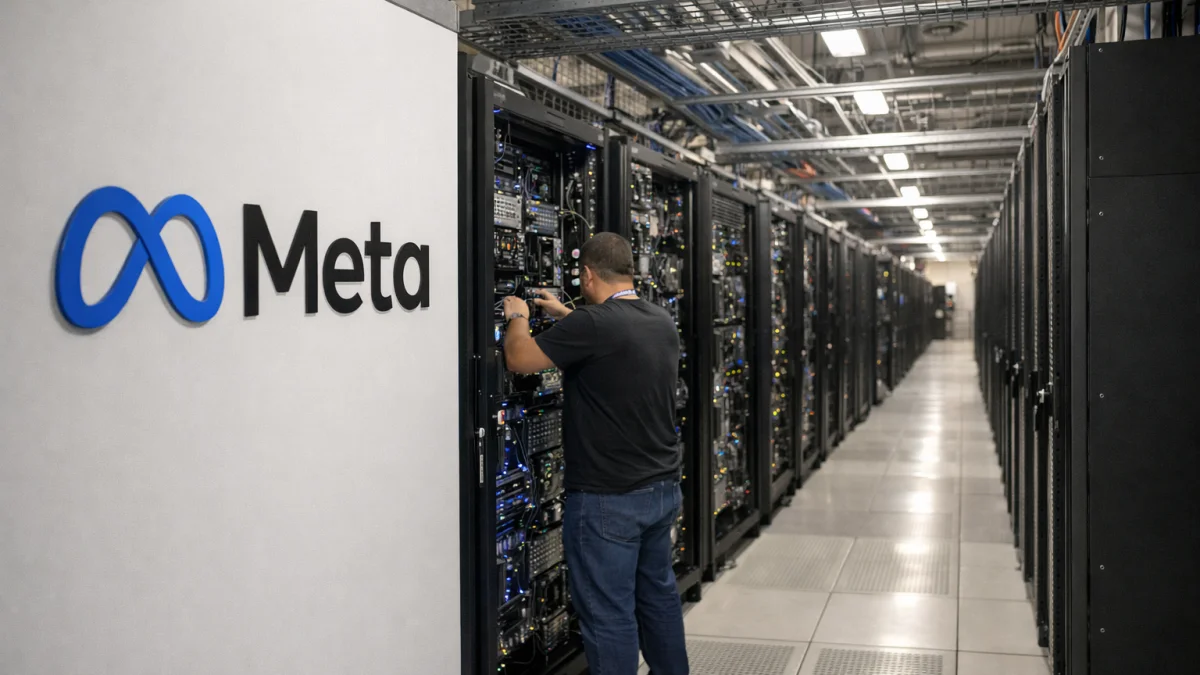


Meta Platforms' reported plan to launch a cloud computing business that would sell access to its artificial intelligence infrastructure marks a potentially important shift in the economics of the AI industry. Rather than using its rapidly expanding network of AI data centers exclusively for internal products and research, the company is reportedly exploring ways to commercialize excess computing capacity by offering cloud services to outside developers and enterprises. According to reporting by Bloomberg, cited by Reuters, the initiative remains under development and Meta has declined to comment publicly on the plans.
The significance extends beyond a single company's strategy. If implemented, the move would signal that AI infrastructure itself—not only AI models or applications—is becoming a competitive commercial market. It would also bring Meta into more direct competition with established cloud providers including Amazon Web Services, Microsoft Azure and Google Cloud, while challenging newer AI infrastructure providers such as CoreWeave and Nebius. Markets immediately reflected that interpretation, with Meta shares rising sharply while several AI-focused infrastructure companies declined following the reports.


Meta's reported strategy reflects the unprecedented scale of investment now flowing into AI infrastructure. The company has dramatically increased capital expenditure to build data centers, acquire advanced AI chips and expand computing capacity needed for large language models and AI services. Those investments have prompted recurring investor questions about how quickly they can generate financial returns. Analysts have increasingly focused not only on the technological capabilities produced by AI spending but also on the utilization rates of expensive computing assets.
Selling cloud access would offer one potential answer. Instead of treating AI infrastructure solely as a cost supporting advertising, consumer AI assistants and internal research, Meta could transform portions of its computing network into a revenue-generating business. Such an approach resembles traditional cloud computing economics, where providers maximize returns by keeping expensive infrastructure utilized as consistently as possible.
The reported initiative also illustrates how competitive dynamics within AI are evolving. During the first phase of the generative AI boom, competition centered on acquiring graphics processors, constructing data centers and developing frontier AI models. Increasingly, companies are seeking ways to monetize those assets through multiple revenue streams. Industry observers note that computing capacity itself has become a scarce commercial resource as startups and enterprises seek alternatives to building their own infrastructure.
That evolution could reshape competitive relationships across the technology sector. Meta has historically been one of the world's largest consumers of AI infrastructure rather than a supplier of commercial cloud services. Entering the cloud market would diversify its business beyond digital advertising while creating new overlaps with companies that are simultaneously customers, competitors and infrastructure providers.
However, analysts remain divided on what the reported move implies about Meta's broader AI ambitions. Some view commercialization of excess computing capacity as evidence of disciplined capital allocation that could improve returns without slowing AI development. Others argue it may raise questions about whether Meta expects internal demand for computing resources to grow as rapidly as previously anticipated. Reuters reported that analysts have offered differing interpretations, while emphasizing that the plans remain preliminary.
Another implication concerns the broader AI infrastructure market. The sharp reaction among shares of specialized cloud providers demonstrated investor sensitivity to any suggestion that supply conditions could change. If more technology companies begin renting excess AI capacity, competition could intensify in markets that have benefited from shortages of high-performance computing resources. At the same time, several analysts cautioned against interpreting Meta's reported plans as evidence that overall demand for AI infrastructure is weakening, noting that major technology companies continue investing aggressively in new capacity.
The reported initiative also reflects a wider industry pattern. Companies that initially built infrastructure primarily for proprietary AI systems are increasingly evaluating whether those assets can support external customers as well. This trend mirrors the earlier development of cloud computing, when technology firms transformed internal computing capabilities into commercial platforms serving third parties.
For developers and enterprise customers, greater competition among AI infrastructure providers could eventually expand access to computing resources and create additional choices for deploying AI models. Whether Meta ultimately offers hosted access to its own models, raw computing power or both will influence how directly it competes with existing cloud platforms, according to reports describing the plans under consideration.
The current situation remains fluid. Meta has not officially confirmed the reported cloud strategy, and Reuters reported that the company declined to comment. Investors, customers and competitors are therefore monitoring whether the company formally announces a cloud infrastructure business, how it would price computing services, what products it would initially offer, and whether the initiative represents a limited monetization of surplus capacity or a broader long-term expansion into commercial cloud computing. Those decisions will determine whether Meta's reported pivot becomes a significant new front in the global competition over AI infrastructure.