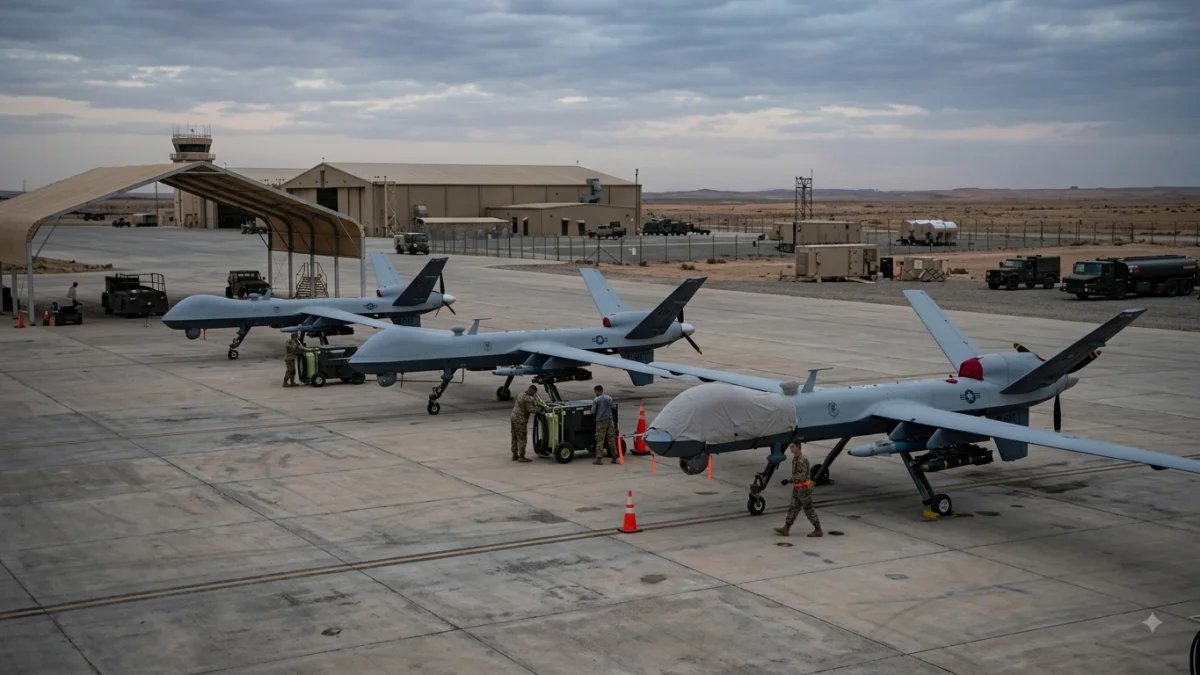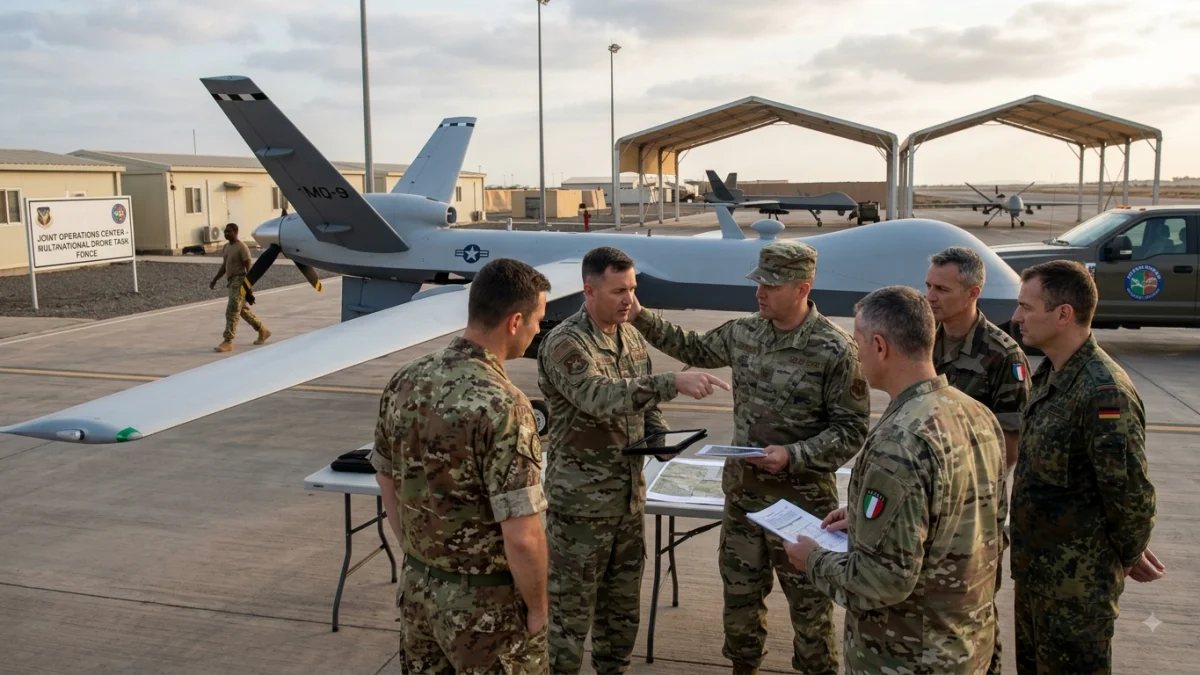


The United States is creating a new multinational attack-drone task force in the Middle East as heavy combat losses of MQ-9 Reaper drones expose the limits of relying on a relatively expensive, long-endurance aircraft in increasingly contested airspace.
U.S. Central Command said on Aug. 13 that Task Force Falcon Strike will combine U.S. and regional military personnel around one-way attack drones operating across air, surface and subsurface domains. Regional partners are still being consulted and formally invited, meaning the multinational structure is being established but its final membership and operational scope have not yet been publicly defined. The initiative builds on Task Force Scorpion Strike, a U.S. drone unit established about nine months earlier.


The timing is significant. The MQ-9 Reaper has remained a major U.S. intelligence, surveillance and strike platform during the conflict with Iran, but its attrition has become a measure of how quickly the economics of drone warfare are changing. Air & Space Forces Magazine reported in May that nearly 30 MQ-9s had been lost in operations against Iran, citing people familiar with the matter. The Air Force's MQ-9 fleet had fallen to about 135 aircraft by May, according to Lt. Gen. David Tabor, although he told senators that the service could still meet its worldwide combat requirements.
More recent reporting has pointed to substantially higher losses. A report circulated on Aug. 13-14 said the United States had lost at least 45 MQ-9s during the Iran war, or roughly a quarter of its prewar fleet, citing three U.S. officials. Another U.S. official said not every loss resulted from a shoot-down. Because the figure has not been publicly confirmed by the Pentagon, it is best treated as an attributed assessment rather than an established official total.
The operational lesson is not that the Reaper has become useless. On the contrary, Air Force Chief of Staff Gen. Kenneth Wilsbach described it in May as the most valuable unmanned platform of Operation Epic Fury, emphasizing the number of strikes it conducted while keeping pilots out of hostile airspace. The aircraft's endurance and ability to combine surveillance with precision weapons remain valuable.
The problem is survivability. The MQ-9 was designed for an era in which U.S. forces generally operated with substantial control of the air. Its relatively slow speed and reliance on persistent flight at predictable altitudes make it more vulnerable to integrated air defenses than faster, stealthier aircraft. Iran has claimed to have used systems including the 358 missile and Majid air-defense system against MQ-9s; independent assessments have identified those systems as designed or suited to engaging low-altitude aerial threats, although individual Iranian claims cannot always be independently verified.
That vulnerability is accelerating a broader change in U.S. acquisition policy. In April, the Air Force sought an "Attritable ISR Aircraft" capable of providing mass at lower cost, with requirements emphasizing rapid production and deployment. Defense officials have said the objective is to replace some Reaper functions with aircraft that can be accepted as expendable in high-threat environments. The Defense Innovation Unit has likewise sought cheaper unmanned aircraft after the losses, reflecting concern that repeatedly exposing aircraft costing tens of millions of dollars to relatively inexpensive air-defense systems is difficult to sustain.
Falcon Strike therefore represents a second, complementary response: not simply replacing the MQ-9, but changing how unmanned strike power is organized. Its planned use of systems operating in the air, on the surface and below the sea could give commanders more ways to distribute risk and complicate an adversary's defenses. The multinational element also reflects the geographic reality of Middle East operations, where U.S. forces operate alongside Gulf and other regional militaries with their own bases, sensors and unmanned capabilities.
The approach builds on a trend already visible in multinational exercises. NATO forces have been testing drone swarms, electronic warfare and counter-drone systems, while U.S. and allied exercises in Europe have integrated unmanned systems, artificial-intelligence-enabled command and control and live data networks. Such activities suggest that interoperability is becoming as important as the performance of any individual drone.
The immediate question is whether Falcon Strike can move from an organizational framework to a genuinely integrated multinational capability. CENTCOM has not publicly identified all prospective participants, nor disclosed the size, specific platforms or rules governing the task force. Those details will determine how much additional capability the initiative actually creates.
For now, the confirmed shift is broader than the loss of a particular aircraft. The United States is moving toward a model in which cheaper, more numerous and more varied unmanned systems operate alongside existing high-end platforms, while regional partners are incorporated into the force structure. The Pentagon is simultaneously pursuing replacements for lost MQ-9s and developing more attritable alternatives. The scale of Falcon Strike's membership, its operational employment and the pace at which new systems enter service remain the key developments to monitor.