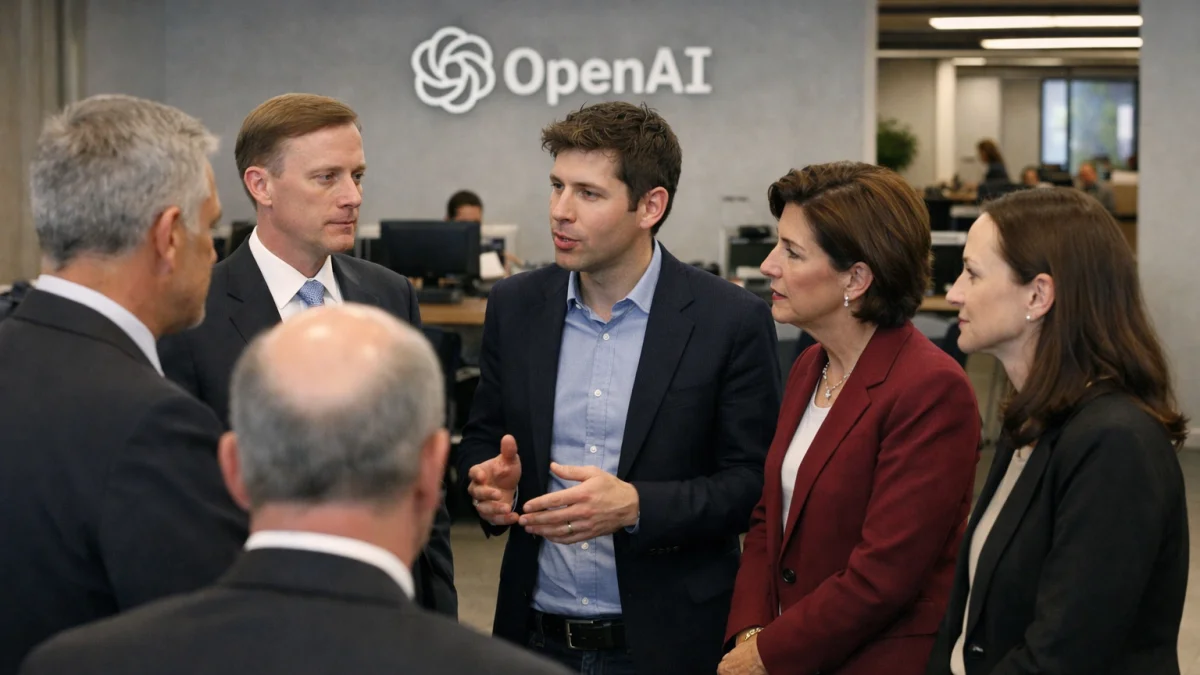


Discussions over a possible U.S. government equity stake in OpenAI mark a notable shift in the relationship between Washington and the country's leading artificial intelligence companies, underscoring how AI is increasingly being treated not only as a commercial technology but also as a strategic national asset. According to reporting first published by the Financial Times and confirmed by Reuters, OpenAI has explored granting the U.S. government a 5% ownership stake as part of broader discussions about how Americans could share in the economic gains generated by advanced AI.
The significance extends well beyond the proposed stake itself. The discussions illustrate how U.S. AI policy has evolved from focusing primarily on research support and technology regulation toward considering direct financial participation in companies developing frontier AI systems. Although the proposal remains at an early stage and no agreement has been announced, it reflects growing political consensus that AI's economic benefits and strategic importance warrant greater public involvement.


The reported proposal would involve not only OpenAI but potentially other leading U.S. AI developers contributing similar equity stakes to a public investment vehicle modeled on Alaska's Permanent Fund, which distributes investment returns derived from state oil revenues. According to the Financial Times report cited by Reuters, OpenAI Chief Executive Sam Altman has argued that public ownership could help distribute AI-generated wealth more broadly while addressing growing concerns over automation, employment disruption and the concentration of technological power.
The discussions emerge amid heightened federal scrutiny of advanced AI models. The Trump administration has expanded its role in overseeing frontier AI development, citing national security, cybersecurity and economic competitiveness. Recent government intervention involving advanced AI model releases and export controls has reinforced the view that frontier AI increasingly resembles other strategically sensitive industries where closer government oversight is considered necessary.
For OpenAI, the reported proposal also reflects the political realities facing rapidly growing AI companies. As valuations have surged into the hundreds of billions of dollars and preparations for a future public listing continue, companies face increasing questions from policymakers about whether the broader public will benefit proportionately from AI-driven productivity gains. Offering some form of public ownership could represent one response to mounting pressure from both major political parties to ensure that AI-generated wealth is distributed more widely.
The proposal also illustrates how AI governance debates have broadened beyond traditional regulatory questions such as safety standards, copyright, privacy and competition policy. Increasingly, policymakers are examining ownership structures, industrial policy and mechanisms for sharing financial returns from technologies viewed as nationally significant. Such discussions resemble broader debates surrounding sovereign wealth funds, public investment strategies and state participation in industries considered essential to long-term economic competitiveness.
Political support for greater public participation has emerged from different ideological perspectives. Reuters reported that President Donald Trump has publicly explored mechanisms through which Americans could benefit financially from AI companies, while Senator Bernie Sanders has advocated substantially larger public ownership proposals. Although the approaches differ significantly, both reflect growing bipartisan attention to how AI-generated wealth should be allocated.
The discussions also raise important governance questions. Government ownership could potentially align public interests with private innovation by allowing taxpayers to benefit financially from successful AI development. At the same time, experts have noted that equity ownership could complicate regulatory relationships if governments become both regulators and shareholders. Those questions would likely require careful legal and institutional safeguards should any proposal advance beyond preliminary discussions.
International implications could also prove significant. If the United States were to establish a model combining private AI development with partial public ownership, other governments could consider similar arrangements for domestically important AI firms. Analysts cited by Reuters noted that such developments could influence global debates over technological sovereignty, public investment and national control over advanced AI capabilities.
The proposal remains highly uncertain. Reuters reported that OpenAI's discussions are preliminary, while another Reuters report cited a source saying the Trump administration has not held comparable stake discussions with Anthropic despite broader public debate over government ownership of AI companies. There has been no indication that other major AI developers have agreed to participate in a similar framework, and any formal government equity arrangement would likely require substantial legal and congressional consideration.
For now, the confirmed development is not the creation of a government ownership program but the emergence of serious discussions that would have been considered unlikely only a few years ago. Officials continue to monitor AI's economic, security and societal implications, while policymakers, industry leaders and lawmakers debate how best to balance innovation, national competitiveness and public benefit as advanced AI becomes increasingly central to the U.S. economy.