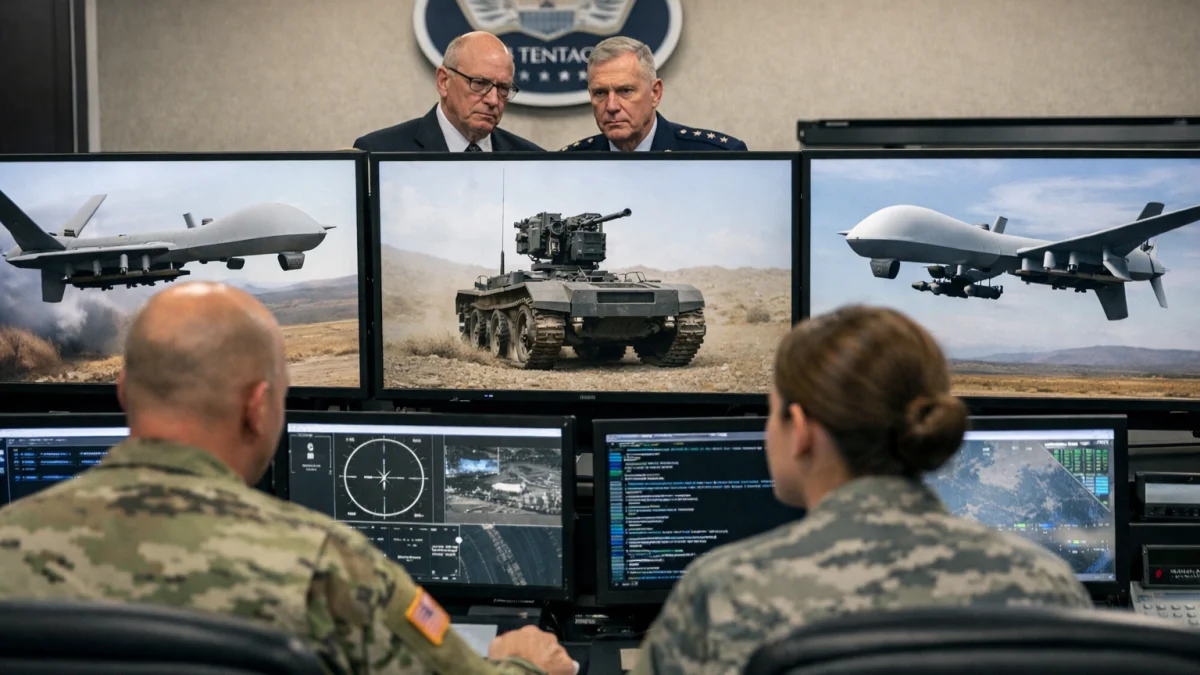


The Pentagon’s decision to rewrite its core autonomous weapons policy within a 90-day deadline has placed human oversight at the center of a broader debate over how quickly the U.S. military should adopt artificial intelligence on the battlefield. The revision effort targets Department of Defense Directive 3000.09, the policy framework governing the development, testing, and deployment of autonomous and semi-autonomous weapon systems, after a presidential memorandum directed the Pentagon to update the rules while reducing barriers to faster AI adoption.
The significance of the rewrite extends beyond a policy update. Directive 3000.09 has served as the Pentagon’s primary mechanism for defining how much human judgment must remain involved when weapons systems use autonomous functions. The current framework, updated in 2023, requires autonomous and semi-autonomous systems to be designed so commanders and operators can exercise appropriate levels of human judgment over the use of force. Changing that framework during a period of rapid AI development could influence military procurement, weapons testing standards, battlefield operations, and the relationship between human decision-makers and increasingly capable machine systems.


The Pentagon has argued that existing policies must adapt to technological competition and the growing role of artificial intelligence in defense operations. The administration’s directive calls for an updated approach intended to support adoption of AI capabilities, including commercial and open-source technologies, while maintaining alignment with national security objectives. Supporters of a faster revision process argue that lengthy approval structures could slow innovation at a time when military planners are examining autonomous systems for logistics, intelligence, surveillance, targeting support, and unmanned platforms.
The central issue is how the revised policy will define meaningful human involvement. Military officials and technology developers have increasingly explored systems that can process information, identify patterns, and assist with operational decisions at speeds beyond human capacity. The challenge for policymakers is determining where human authorization, review, or intervention remains necessary, particularly in situations involving lethal force.
Concerns about the compressed timeline have already drawn congressional scrutiny. Senator Ruben Gallego asked Defense Secretary Pete Hegseth for details on how the Pentagon would manage risks to U.S. personnel, allies, and civilians while rewriting the directive. In his letter, Gallego questioned whether safeguards against unintended harm would remain effective during the transition and raised concerns about potential friendly-fire incidents or civilian casualties if oversight requirements were weakened.
The debate reflects a longer-running international discussion about autonomous weapons governance. Governments, researchers, and international organizations have struggled to establish common standards for systems that can operate with varying levels of independence. The United States has historically focused on maintaining responsible use through internal policy controls rather than seeking broad international restrictions, making the Pentagon’s internal rules particularly important in defining operational limits.
The rewrite also has implications for the defense technology sector. Companies developing artificial intelligence models, autonomous vehicles, drones, and battlefield software increasingly depend on government adoption pathways. Changes to testing requirements, certification processes, and human-control standards could affect how contractors design systems and compete for military programs. The Pentagon’s expanding use of AI partnerships with technology companies has already highlighted tensions between commercial innovation and restrictions on military applications.
Historically, military technology transitions have often created similar questions about control and accountability. Advances in precision-guided weapons, cyber capabilities, and unmanned aircraft have required new operational rules and oversight structures. Autonomous systems introduce a different challenge because decision-making processes may involve machine learning models whose outputs can be difficult to predict or explain, increasing the importance of testing, verification, and operational safeguards.
Experts and policymakers differ over the balance between speed and caution. Supporters of rapid modernization argue that adversaries are also investing in autonomous military capabilities and that the United States needs flexible rules to remain competitive. Critics argue that accelerating deployment without clearly defined oversight standards could create operational and legal risks, especially in complex environments where identification and targeting decisions carry significant consequences.
The Pentagon’s confirmed task is to produce a revised Directive 3000.09 within the 90-day period established by the administration and continue reviewing the policy framework afterward. The unresolved questions involve the final language of the new directive, how it will define human judgment requirements, and how the Pentagon will ensure testing and accountability standards remain in place as AI-enabled military systems expand.