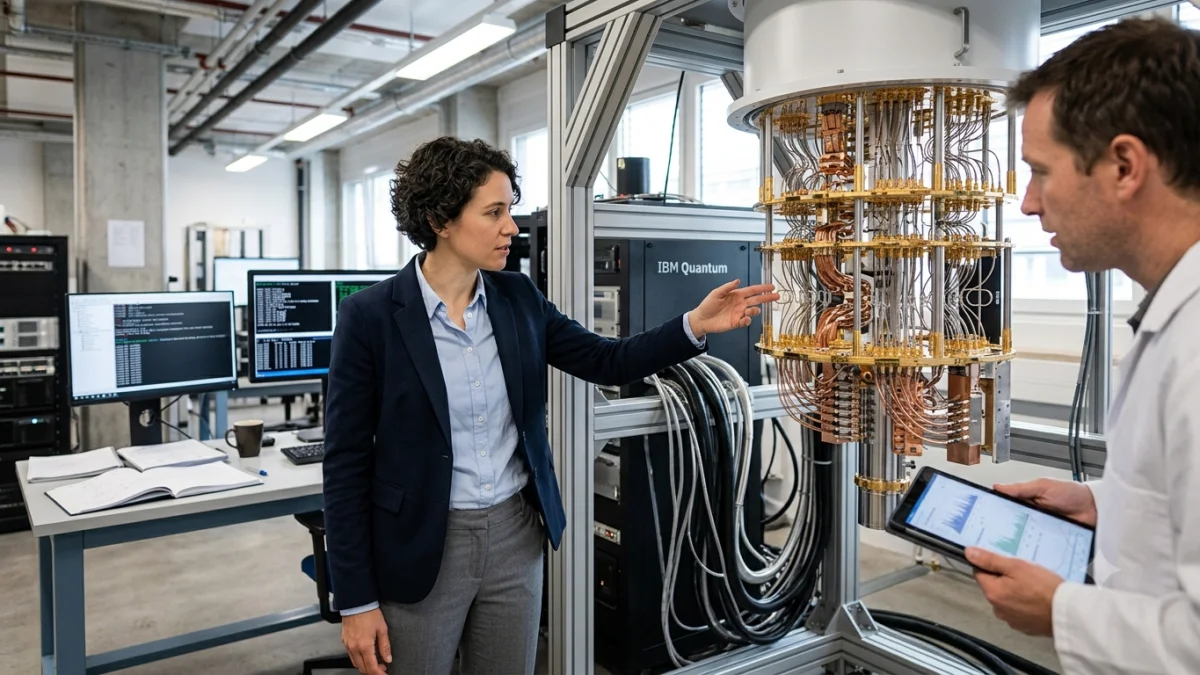


NEW YORK — Quantum computers are beginning to move beyond experimental demonstrations and serve as practical scientific research tools, with researchers reporting advances in materials science, biology and chemistry that suggest the technology is becoming increasingly useful alongside conventional supercomputers rather than replacing them.
A series of studies published this year by researchers from IBM, the U.S. Department of Energy-funded Quantum Science Center, Cleveland Clinic and Japan's RIKEN have shown quantum systems accurately simulating magnetic materials and biologically significant molecules at scales previously considered beyond the reach of today's quantum hardware. The findings are being presented as evidence that quantum computing is entering a phase in which it can contribute to scientific discovery through hybrid workflows combining quantum and classical computing.


In one study announced in March, IBM and collaborators said a quantum computer reproduced neutron-scattering results for real magnetic materials, a benchmark the company said demonstrated that quantum processors can function as reliable scientific instruments for materials research. The work relied on quantum-centric supercomputing, in which quantum processors perform selected calculations while classical high-performance computers manage other parts of the workflow.
Further results released in May showed researchers from Cleveland Clinic, RIKEN and IBM modeling protein complexes containing more than 12,000 atoms using quantum hardware integrated with two of the world's most powerful supercomputers. The researchers said the simulations represented the largest biologically meaningful molecular systems yet studied with quantum computers and could help advance research into chemistry, biology and medicine.
"For years, quantum computing has been a promise. Now, quantum computers are producing results that matter to science," IBM Research Director Jay Gambetta said when the protein simulation results were announced.
The developments come as technology companies seek to demonstrate practical applications for quantum computing after years of focusing primarily on hardware development. Last week, IBM announced what it described as a new milestone toward "quantum advantage," saying multiple research teams had demonstrated calculations beyond the practical capabilities of classical methods while also introducing techniques to verify the correctness of quantum results. Independent researchers have said the claims represent an important step, while noting that they will require continued scientific scrutiny and validation.
Scientists caution that today's systems remain specialized and are not general-purpose replacements for conventional computers. Instead, researchers increasingly view quantum processors as accelerators for carefully selected scientific problems, particularly in materials discovery, chemistry and condensed-matter physics, where quantum effects are difficult for classical computers to model efficiently.
Research institutions and technology companies say future work will focus on expanding these hybrid computing approaches while improving hardware reliability and scaling toward fault-tolerant quantum systems capable of tackling broader classes of scientific problems.