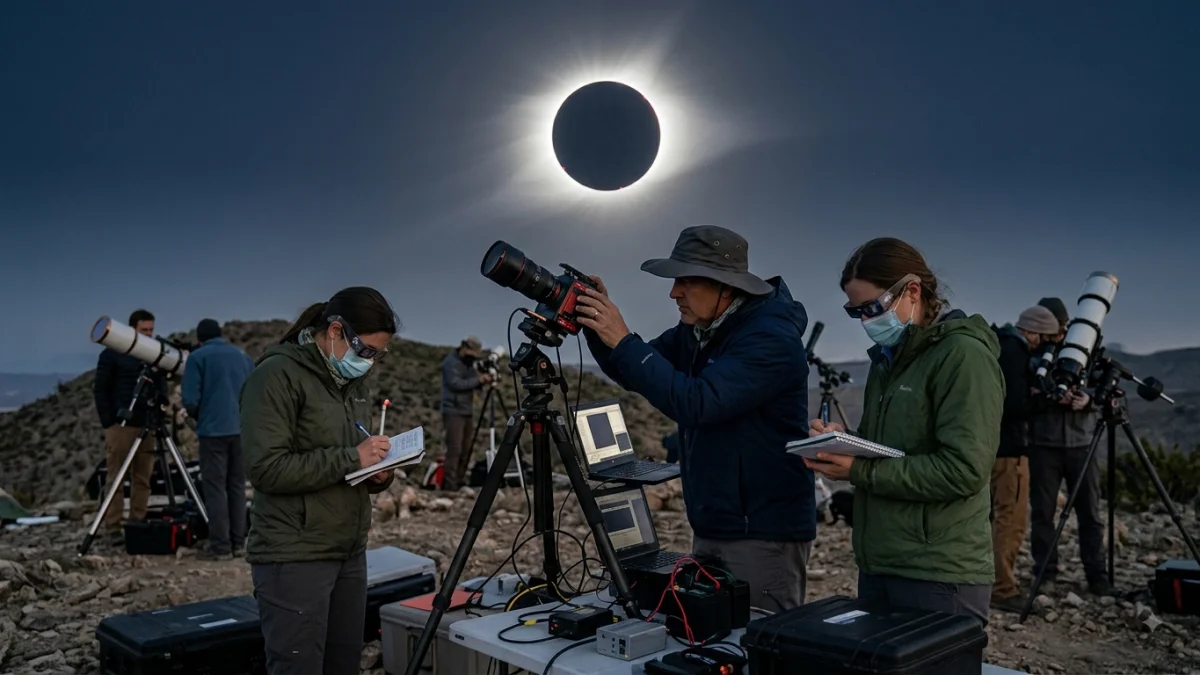


MADRID — Scientists used Wednesday’s total solar eclipse across parts of Europe to observe the Sun’s outer atmosphere, combining ground-based measurements with spacecraft and airborne instruments to test models of the solar corona and improve understanding of space weather.
The Aug. 12 eclipse crossed Greenland, Iceland, northern Spain and a small part of Portugal, with totality lasting only a few minutes. When the Moon completely blocked the Sun’s bright disk, the much fainter corona became visible, providing researchers with a natural opportunity to study structures that are otherwise difficult to observe.


The European Space Agency’s Solar Orbiter spacecraft conducted a special observation campaign before the eclipse. Data from its Polarimetric and Helioseismic Imager were used to map magnetic fields on the Sun’s far side and feed computer models designed to predict the corona’s structure during the eclipse, according to the Max Planck Institute for Solar System Research. Researchers planned to compare those predictions with images collected during totality.
ESA said the comparison could help scientists assess how accurately models reproduce the magnetic environment that shapes the corona. The corona is also the region where the solar wind is accelerated and where coronal mass ejections originate, phenomena that can affect satellites, communications systems and power infrastructure on Earth.
NASA-funded teams also prepared to observe the eclipse from the air. A WB-57 aircraft was equipped with cameras designed to track the Sun and capture observations across infrared and visible wavelengths, allowing researchers to examine the corona and prominences while extending the time available for scientific measurements.
In Spain, researchers from Italy tested a prototype Circular Slit Spectrometer designed to capture the spectrum of the corona in a single image. Principal investigator Federico Landini of the Astrophysical Observatory of Turin said the instrument was intended to overcome the limitations of conventional spectrometers, which can require lengthy scans while the corona changes rapidly.
The eclipse was the only total solar eclipse of 2026 and the first total eclipse visible from mainland Europe since 1999, according to the Instituto de Astrofísica de Canarias.
Researchers are now expected to analyze the eclipse observations and compare them with the models and measurements collected before and during totality. The resulting data will be used to assess the performance of current solar-corona models and inform future observations of solar activity.