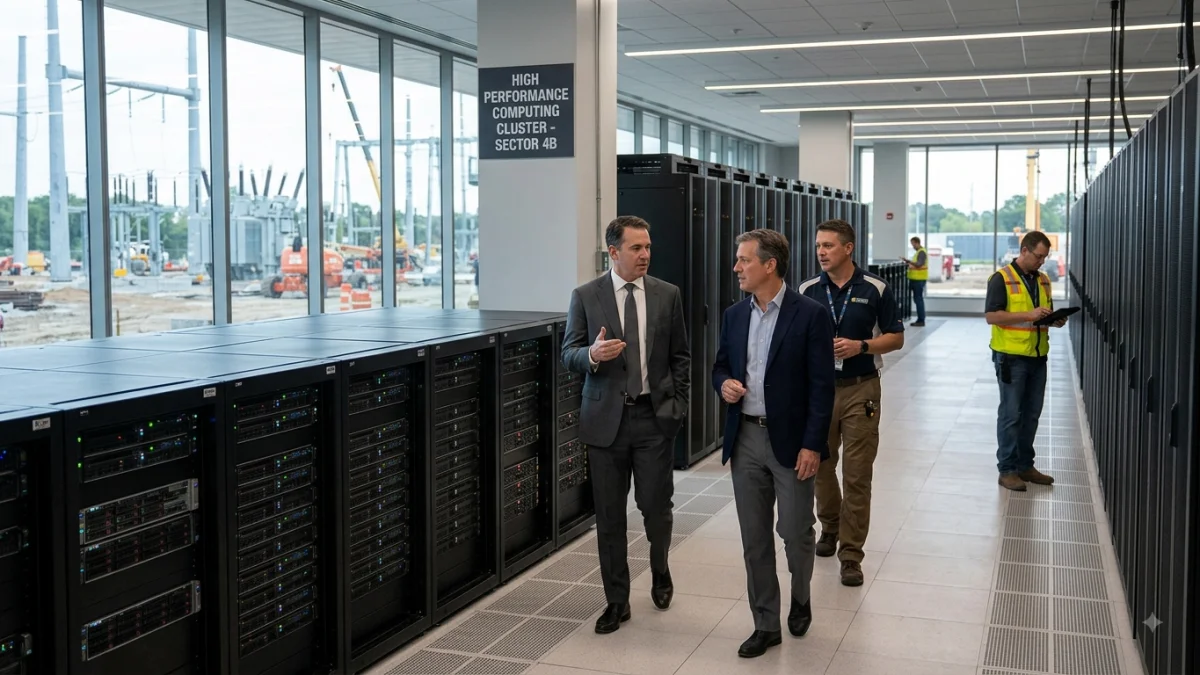


Wall Street’s growing commitment to financing artificial-intelligence infrastructure is shifting the AI boom into a new phase: from a technology spending cycle increasingly dependent on the balance sheets of major companies to an infrastructure market seeking large pools of institutional capital. The clearest sign came this week, when Nvidia announced partnerships with Apollo Global Management, BlackRock, Blackstone, Brookfield, Goldman Sachs and KKR to establish financing platforms intended to mobilize more than $500 billion of third-party capital for AI infrastructure.
The significance is less the headline figure than what it says about the financing needs of the industry. Nvidia said the platforms are designed to expand access to its computing infrastructure for AI developers, enterprises, governments and cloud providers. Chief Executive Jensen Huang said Nvidia could backstop up to $125 billion, or 25% of potential deals. But the company did not disclose how much each financial institution would provide, when the capital would be deployed or how much of the proposed $500 billion represents already planned transactions. The commitments therefore represent a financing framework rather than a $500 billion check.


That distinction matters because the capital requirements of AI infrastructure are expanding beyond the cost of processors. Data centers require land, buildings, electricity connections, cooling systems, networking equipment and long-term power arrangements, often before they generate substantial revenue. The financing structure being assembled by Nvidia and major investment firms seeks to turn the resulting computing capacity into an asset capable of attracting institutional investors, allowing customers to pay for computing over time rather than financing the entire build-out upfront.
Wall Street has already been benefiting from this spending cycle. Reuters reported in July that technology companies' efforts to finance AI infrastructure were increasing investment-banking activity, including capital raising and loans, while banks were positioning themselves for what some executives described as an AI “super cycle.” The latest Nvidia initiative broadens that role by connecting AI infrastructure directly with private capital, asset managers and structured financing.
There is evidence that this transition is already changing the financial architecture of the sector. The Bank for International Settlements said in March that hyperscalers had increasingly used borrowing to finance AI infrastructure, with U.S. corporate bond issuance by major technology companies topping $100 billion in 2025. It also identified so-called “shadow borrowing” through structures in which private-credit funds and other investors finance infrastructure outside the traditional corporate balance sheet.
The Bank of England has raised a related concern. Its July Financial Stability Report said AI companies were increasingly turning to external finance, particularly debt, and that this had accelerated in the first half of 2026. The central bank said financial-stability risks remained contained because the outstanding stock of AI-related debt was still relatively modest, but warned that those risks could become more significant if AI investment and associated borrowing continued to expand rapidly.
The infrastructure itself also presents constraints that financing alone cannot resolve. AI data centers require enormous and concentrated amounts of electricity, making access to generation and transmission capacity an increasingly important condition for expansion. Research published this year has found that the concentration of AI data centers could create localized pressure on power systems, particularly in regions where large computing loads are arriving faster than grids can expand.
That creates a distinction between financial capacity and physical capacity. Wall Street can provide debt and equity, but it cannot by itself accelerate permitting, construct transmission lines, secure generation or overcome shortages of specialized equipment. The ability of AI companies to convert financing into operating computing capacity will therefore depend on infrastructure delivery as much as investor appetite.
The financing model also changes where risk sits. Nvidia's announcement is intended to bring third-party capital into the sector, reducing the need for technology companies to finance every project directly. At the same time, the proposed arrangements could make financial institutions, private-credit investors and other institutional holders more exposed to the economics of AI infrastructure. The BIS has specifically noted that such links can create new channels through which refinancing pressure or declining private-credit appetite could transmit stress across the financial system.
For Nvidia, the strategy offers a way to expand the market for its computing systems while shifting much of the financing burden to external investors. It also comes after Nvidia's data-center business reached record levels, with fiscal 2026 data-center revenue of $193.7 billion, according to the company's financial results. But the greater use of financing also means investors will pay closer attention to whether AI infrastructure generates sufficient utilization and cash flow to support the capital being committed.
The confirmed development is that Nvidia has established partnerships with six major financial institutions to develop platforms capable of mobilizing more than $500 billion in third-party capital; it is not that the full amount has already been raised or committed. The unresolved questions are the final financing structures, deployment timetable, borrower quality and economics of the underlying projects. Investors and regulators will therefore be watching whether institutional financing expands alongside demonstrable demand and operating cash flows, and whether the physical infrastructure needed to support the AI build-out can keep pace with the capital now being assembled.