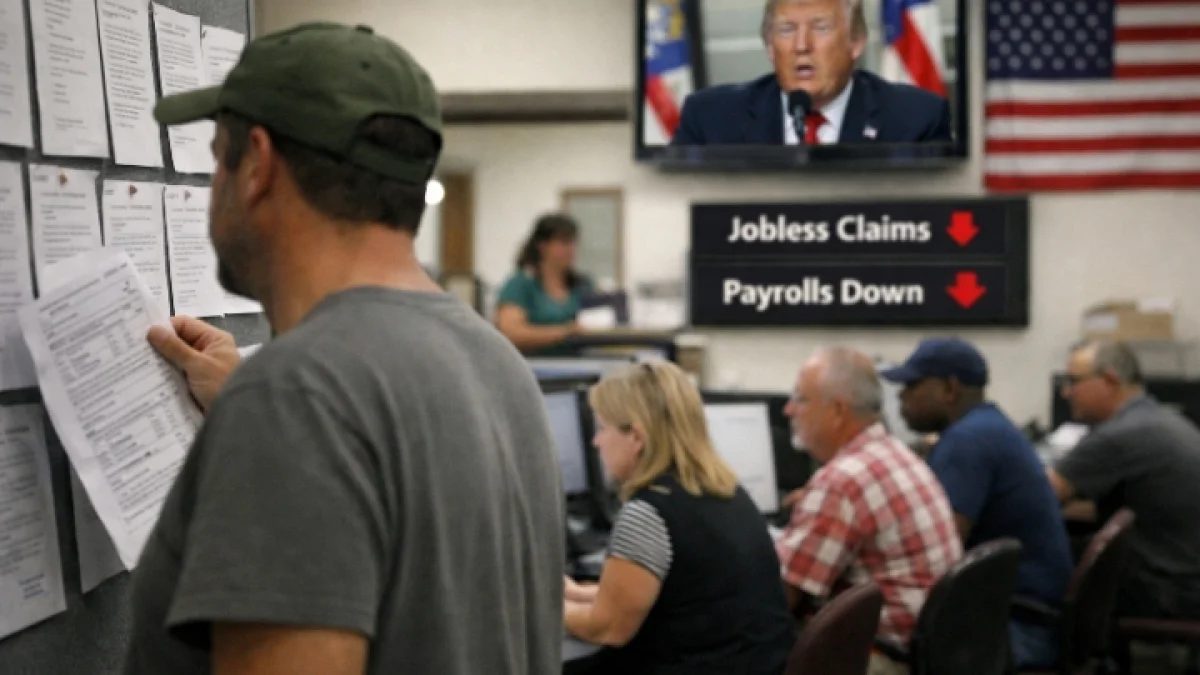


Slowing growth in U.S. employment has emerged as one of the most closely watched economic indicators confronting the Trump administration, with June labor market data pointing to a more cautious hiring environment even as layoffs remain historically limited. The latest figures from the U.S. Bureau of Labor Statistics showed nonfarm payrolls increased by about 57,000 in June, well below economists' expectations, while earlier months were revised downward. The unemployment rate edged down to 4.2%, although the decline coincided with a lower labor force participation rate rather than stronger hiring.
The figures matter because they suggest the U.S. labor market is entering a different phase from the rapid employment expansion that followed the pandemic. Instead of widespread job losses, employers appear increasingly reluctant to expand payrolls, reflecting continued uncertainty over borrowing costs, trade policy, and broader business conditions. For the Trump administration, which has consistently highlighted economic performance as a central measure of its agenda, slower job creation could become an important political and economic challenge as the 2026 congressional midterm elections approach.


The June employment report presents a more nuanced picture than a single headline figure. Payroll growth slowed sharply, but weekly unemployment claims have remained relatively low, indicating companies are generally holding on to existing workers even as they scale back recruitment. Economists have increasingly described the labor market as characterized by "slow hiring, slow firing," with businesses avoiding major layoffs while delaying expansion plans.
Sectoral trends reinforce that interpretation. Health care, social assistance, and professional and business services continued adding jobs, while leisure and hospitality lost employment. Such concentration suggests hiring has become increasingly dependent on a relatively small number of industries rather than broad-based expansion across the economy. The Bureau of Labor Statistics also reported that job openings remained broadly stable in May at around 7.6 million, while hiring and separations changed little, indicating labor demand has cooled without collapsing.
Several factors appear to be weighing on hiring decisions. Elevated interest rates continue to restrain investment-sensitive sectors, while businesses have cited uncertainty surrounding tariffs, supply chains and input costs. Although inflation has eased from earlier peaks, many employers remain cautious about committing to additional permanent staff until there is greater clarity about demand and financing conditions. Analysts have also pointed to slower productivity gains in some industries and continued restructuring among technology and corporate employers following earlier periods of rapid expansion.
For policymakers, the labor market's mixed signals complicate the economic outlook. A slowing pace of employment growth could reduce wage pressures over time, potentially easing concerns about persistent inflation. At the same time, weaker hiring raises questions about whether economic momentum is gradually fading after several years of resilience. Federal Reserve officials typically assess employment alongside inflation when determining monetary policy, meaning future labor market reports will likely receive heightened scrutiny.
The political implications are equally significant. Historically, employment conditions have shaped public perceptions of economic management, although electoral outcomes depend on a broader mix of inflation, wages, household finances and other issues. President Donald Trump has argued that his administration's policies support investment, domestic manufacturing and business confidence. Critics, meanwhile, contend that trade uncertainty, federal workforce reductions and shifting policy priorities have contributed to slower hiring. Those competing interpretations are likely to remain central to political debate heading into the midterms, with future economic releases serving as key evidence for both sides.
Another important aspect of the June report is what it suggests about labor market resilience. Despite weaker payroll growth, unemployment remains comparatively low by historical standards, and weekly jobless claims have not signaled widespread layoffs. That distinction reduces the likelihood that the economy is already experiencing a sharp deterioration in employment conditions. Instead, available evidence points to moderation rather than contraction, though economists differ on how long that balance can be maintained if hiring continues to weaken.
Questions also remain about labor force participation. The decline in the unemployment rate occurred alongside fewer people actively seeking work, underscoring why economists often evaluate multiple indicators rather than relying solely on the headline unemployment figure. Participation trends can influence the availability of workers, wage growth and assessments of underlying labor market strength.
For businesses, investors and policymakers, upcoming employment reports will help determine whether June represented a temporary slowdown or the beginning of a more sustained deceleration. Official data on job openings, hiring activity, wage growth and labor force participation will be monitored alongside inflation, consumer spending and business investment to assess whether the U.S. economy is settling into slower but stable growth or facing broader economic headwinds. At present, the confirmed evidence indicates a labor market that continues to expand, but at a noticeably more restrained pace than earlier in the year, leaving both economic policymakers and political leaders watching closely for signs of the next phase.