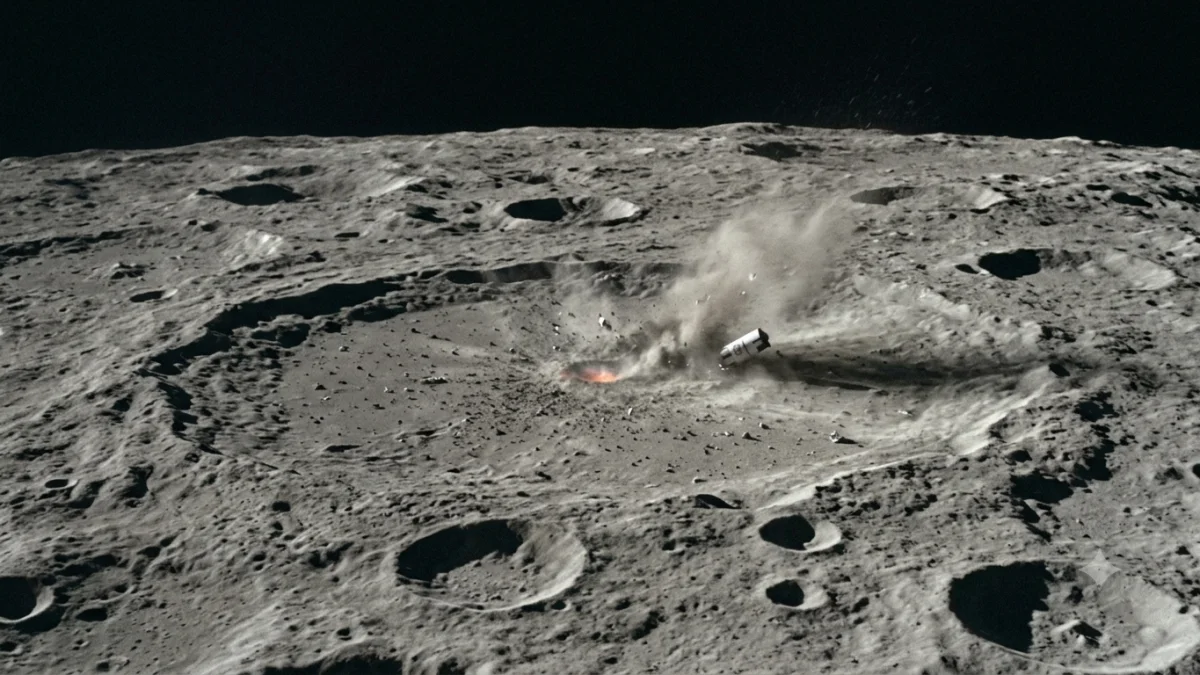


WASHINGTON — A discarded SpaceX Falcon 9 upper stage crashed into the Moon on Wednesday after more than a year drifting through cislunar space, marking an unplanned impact that scientists said could provide valuable data on lunar impact processes while underscoring the growing challenge of managing spacecraft debris beyond Earth orbit.
The roughly four-ton rocket stage struck the lunar surface at about 06:35 UTC (2:35 a.m. EDT) near the Einstein crater region on the Moon's western limb, according to tracking by independent astronomer Bill Gray and researchers who had forecast the collision. The object was the upper stage from a January 2025 Falcon 9 mission that launched Firefly Aerospace's Blue Ghost lunar lander and ispace's Hakuto-R Mission 2.


The impact posed no threat to Earth or operational spacecraft. Scientists had predicted the collision would excavate a fresh crater several dozen meters across and eject a plume of lunar dust and debris. Because the impact occurred near the Moon's edge as viewed from Earth, immediate confirmation through direct imaging was limited, and researchers said observations from telescopes and future spacecraft imagery would be needed to characterize the site.
Unlike most Falcon 9 upper stages, which are directed to re-enter Earth's atmosphere after completing their missions, the stage remained in a high-energy trajectory following the lunar launch. Gravitational interactions and solar influences gradually altered its orbit until it intersected the Moon.
Researchers had viewed the event as a rare opportunity to study an artificial impact under known conditions. In a pre-impact study, scientists said observations could improve understanding of ejecta dynamics, crater formation and techniques for locating impacts that may support future lunar science and exploration missions.
The incident also renewed attention to the management of spacecraft hardware in cislunar space as government agencies and commercial companies increase the pace of lunar missions. Experts have said that while accidental impacts on the Moon present little immediate hazard, they highlight the need for improved tracking and disposal strategies for spacecraft operating beyond low Earth orbit.
NASA is expected to use future lunar imagery to identify the new impact site and assess the crater and surrounding ejecta. As of Wednesday, no official reports indicated any effect on ongoing lunar missions or infrastructure, and scientists continued reviewing observational data collected during the event.