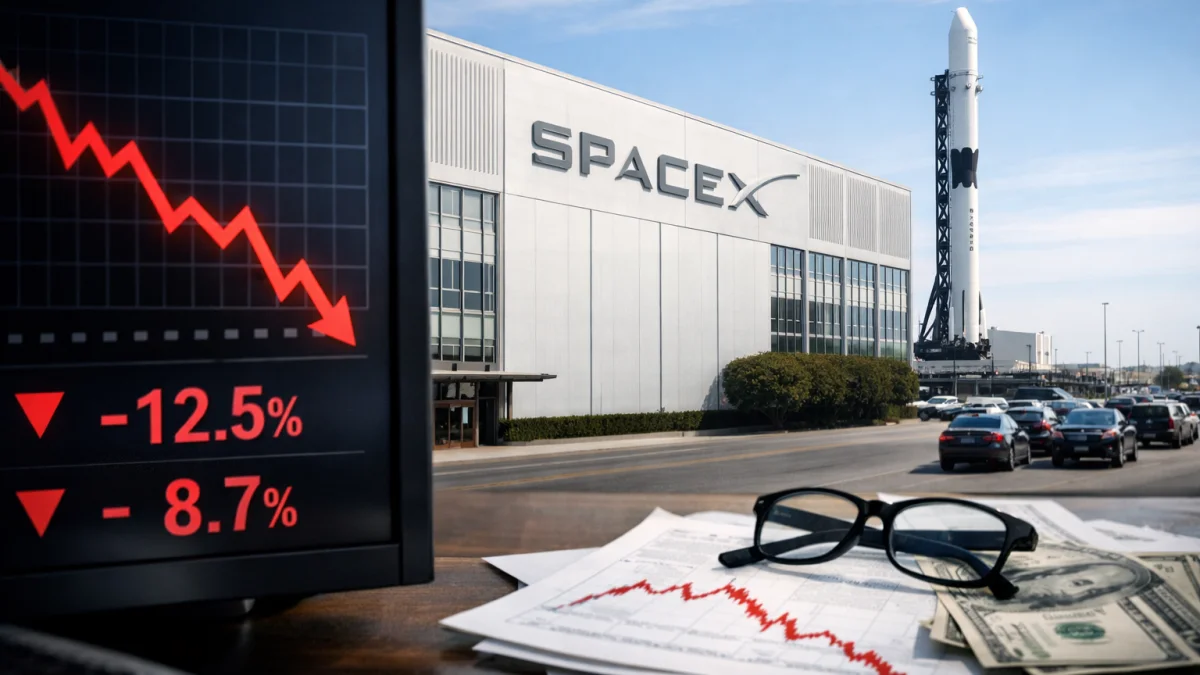


HAWTHORNE, California — Shares of SpaceX declined this week as investor enthusiasm following the company’s record-setting initial public offering began to cool, with the stock falling more than 6% on Thursday after a sharp rally in its first days of trading, according to market data and company filings.
The pullback followed a highly anticipated public debut that valued the company at more than $1.7 trillion at its offering price and briefly pushed its market capitalization above $2 trillion as investors rushed to buy shares. Despite the recent decline, SpaceX shares remained well above their IPO price as of Friday, according to market reports.


Analysts and investors attributed the downturn largely to profit-taking after an initial surge fueled by strong retail and institutional demand. Reuters reported that retail investors purchased more than $300 million worth of SpaceX shares during the early days of trading, although buying activity slowed later in the week.
“The space sector has seen a strong run up,” Chris Beauchamp, chief market analyst at IG Group, told Reuters earlier this month, adding that investors were weighing whether expectations could be sustained after the IPO-driven rally.
The decline also came as investors assessed SpaceX’s broader expansion plans. The company recently received investment-grade credit ratings from major agencies including Moody’s, Fitch and S&P Global Ratings, which cited the strength of its launch and satellite communications businesses while noting risks associated with its planned investments in artificial intelligence.
According to Reuters, SpaceX is pursuing major AI-related initiatives that could require substantial capital expenditures. Ratings agencies said the company maintains a stable outlook but highlighted uncertainty surrounding the profitability and competitive environment of those ventures.
Market observers also pointed to the stock’s high valuation. Several analysts have noted that investors are continuing to debate how to assess the company’s future earnings potential given its ambitious expansion plans and dominant position in commercial launch services and satellite communications.
The share-price decline affected other publicly traded space companies as well. Reuters reported that several firms across the sector posted losses as investors reassessed valuations following SpaceX’s market debut.
As of Friday, SpaceX remained among the world’s most valuable publicly traded companies despite the recent pullback. The company had not issued a statement specifically addressing the stock’s decline, while investors continued to monitor trading activity and the company’s upcoming business initiatives.