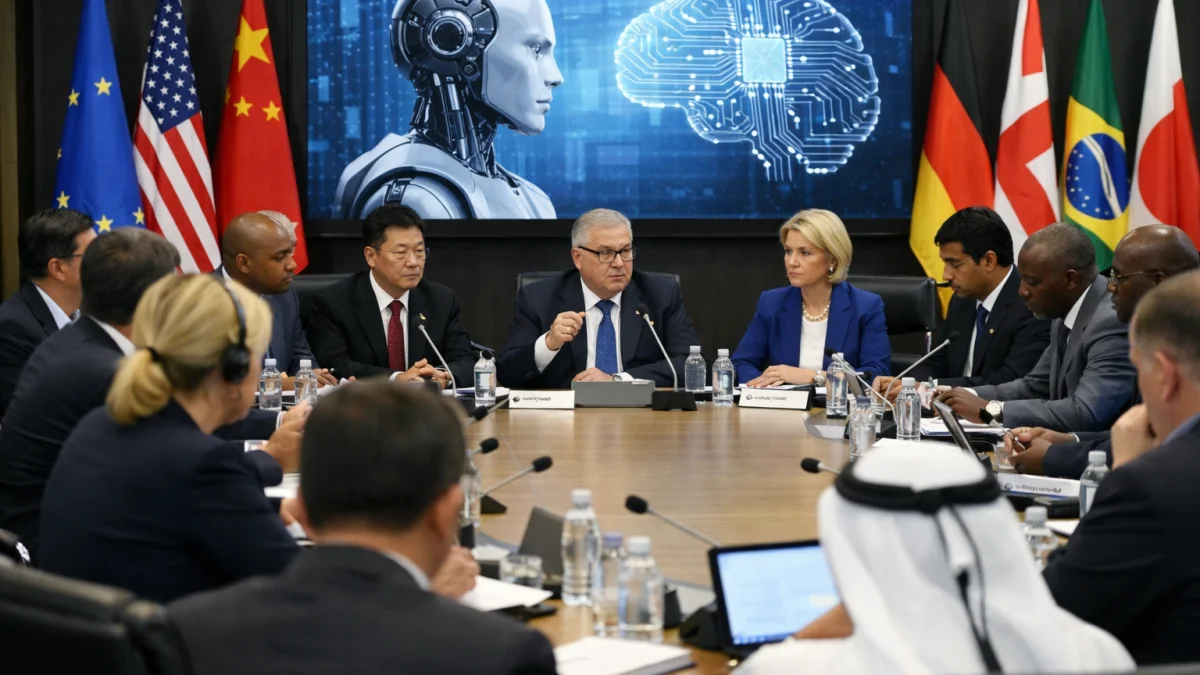


Artificial intelligence governance has entered a period in which regulatory activity is accelerating across multiple jurisdictions, yet global oversight remains fragmented as technological advances continue to outpace policy coordination. That gap has become more visible following the release of the United Nations' first scientific assessment of AI, which concluded that the technology's capabilities are advancing faster than scientific understanding and governments' ability to regulate them. The report also coincides with renewed international discussions on AI governance under the UN framework and continuing implementation of national and regional regulatory initiatives.
The significance of this moment lies not in an absence of regulation but in the growing divergence between competing governance models. Rather than converging on common international standards similar to those governing aviation, nuclear safety or telecommunications, governments have pursued different legal, economic and strategic approaches reflecting domestic priorities, national security concerns and industrial policy. As AI systems become increasingly global while regulation remains largely national or regional, companies, regulators and users face an increasingly complex governance landscape.


Several jurisdictions have moved ahead with comprehensive frameworks. The European Union has continued implementing the AI Act through a phased timetable based on risk categories. The United States has generally relied more heavily on agency guidance, executive actions and sector-specific oversight than on a single national AI law. China has expanded regulatory requirements covering generative AI, recommendation algorithms and synthetic media while maintaining strong state oversight. Other countries have adopted voluntary codes, regulatory sandboxes or emerging legislative proposals reflecting different balances between innovation, competition and risk management.
These differing approaches illustrate one of the central challenges facing global AI governance. Governments broadly agree on many objectives—including improving transparency, reducing harmful bias, protecting privacy, strengthening cybersecurity and promoting trustworthy AI—but often disagree on the mechanisms needed to achieve them. Differences over liability, enforcement, data governance, content moderation and national security have made internationally harmonized rules difficult to establish.
Technological change has compounded those policy challenges. Generative AI evolved rapidly from conversational systems into increasingly capable multimodal and agentic models able to perform complex sequences of tasks with limited human intervention. Regulators frequently face a moving target in which legislative proposals drafted to address one generation of systems require interpretation or revision before implementation is complete. Researchers have argued that technical definitions of emerging autonomous AI systems often differ from legal definitions embedded in regulatory frameworks, creating potential gaps between regulation and actual system capabilities.
The UN scientific panel identified that mismatch as a growing governance problem. According to its preliminary assessment, policymakers require reliable scientific evidence to regulate AI effectively, yet scientific understanding is itself struggling to keep pace with increasingly capable systems. The panel highlighted concerns ranging from deceptive model behavior and autonomous decision-making to misuse in cyberattacks, fraud, misinformation and biological risks while emphasizing that many governments lack sufficient technical capacity to independently evaluate frontier AI systems.
Another source of fragmentation stems from uneven institutional capacity. Advanced AI development remains concentrated among a relatively small number of companies and countries, while many governments lack specialized regulatory expertise, computing infrastructure or independent evaluation capabilities. The OECD has found that although AI adoption in government is expanding across member countries, operational governance mechanisms—including mandatory risk assessments, post-deployment audits and enforceable oversight—remain substantially less developed than high-level policy frameworks.
Economic competition further complicates international coordination. Governments increasingly view AI as a strategic technology with implications for productivity, defense, semiconductor supply chains and geopolitical influence. Policies designed to promote domestic AI industries or restrict access to advanced computing technologies may therefore conflict with efforts to establish globally consistent governance standards. This intersection of industrial policy, national security and technological leadership has made comprehensive international agreements more difficult than in many previous technology sectors.
Private companies also occupy an unusually influential position in AI governance. Frontier model developers often possess greater technical expertise, computing resources and evaluation capabilities than many public regulators. While governments have increasingly sought consultation with industry, researchers and civil society, policymakers continue debating how responsibility should be shared between voluntary corporate commitments and legally enforceable public oversight. The resulting governance ecosystem combines legislation, voluntary safety frameworks, technical standards, industry commitments and international principles rather than a single coherent regulatory architecture.
Recent UN initiatives illustrate attempts to narrow those gaps without imposing uniform global regulation. Alongside the scientific assessment, the UN announced an AI for Good Global Commission intended to bring together governments, international organizations and technology leaders to support dialogue on governance, capacity-building and international cooperation. The initiative reflects growing recognition that many countries require greater technical expertise and institutional support if global governance is to become more inclusive.
The broader challenge extends beyond safety alone. International discussions increasingly encompass questions of economic inequality, environmental impacts, intellectual property, labor markets and access to computing infrastructure. A separate UN report warned that uneven AI development risks widening global inequalities unless governance frameworks better address disparities in technological capacity between advanced and developing economies.
As of July 2026, global AI governance is characterized by expanding regulatory activity rather than regulatory convergence. Governments, international organizations and industry continue developing new oversight mechanisms, while implementation of existing frameworks remains uneven across jurisdictions. Officials are monitoring the effectiveness of emerging regulations, progress in international coordination under the UN process, and whether governance mechanisms can adapt quickly enough to increasingly capable AI systems without losing pace with technological innovation.