LONDON — Archaeologists have announced the discovery of a 5,000-year-old monument near Stonehenge that researchers believe may represent an early precursor to the world-famous prehistoric site, according to findings released on Thursday amid ongoing research into Britain’s Neolithic landscape.
The newly identified structure was uncovered near Bulford, about three miles (five kilometers) from Stonehenge on Salisbury Plain in southern England. Researchers from Wessex Archaeology said evidence indicates the monument consisted of two large wooden posts positioned about 120 meters apart and aligned with the summer solstice sunrise and winter solstice sunset. Radiocarbon dating suggests the site dates to around 3000 BC, approximately 500 years before the earliest phases of Stonehenge.
The discovery was announced as thousands of visitors prepared to gather at Stonehenge for the annual summer solstice observance. Archaeologists said the alignment mirrors the solar orientation later incorporated into Stonehenge, raising the possibility that the earlier monument influenced subsequent ceremonial construction in the region.
Phil Harding, the archaeologist who led the excavation for Wessex Archaeology, described the find as highly significant. “It really is a once-in-a-lifetime find,” Harding said in comments released alongside the research. Researchers cautioned, however, that the precise relationship between the wooden monument and Stonehenge remains under investigation.
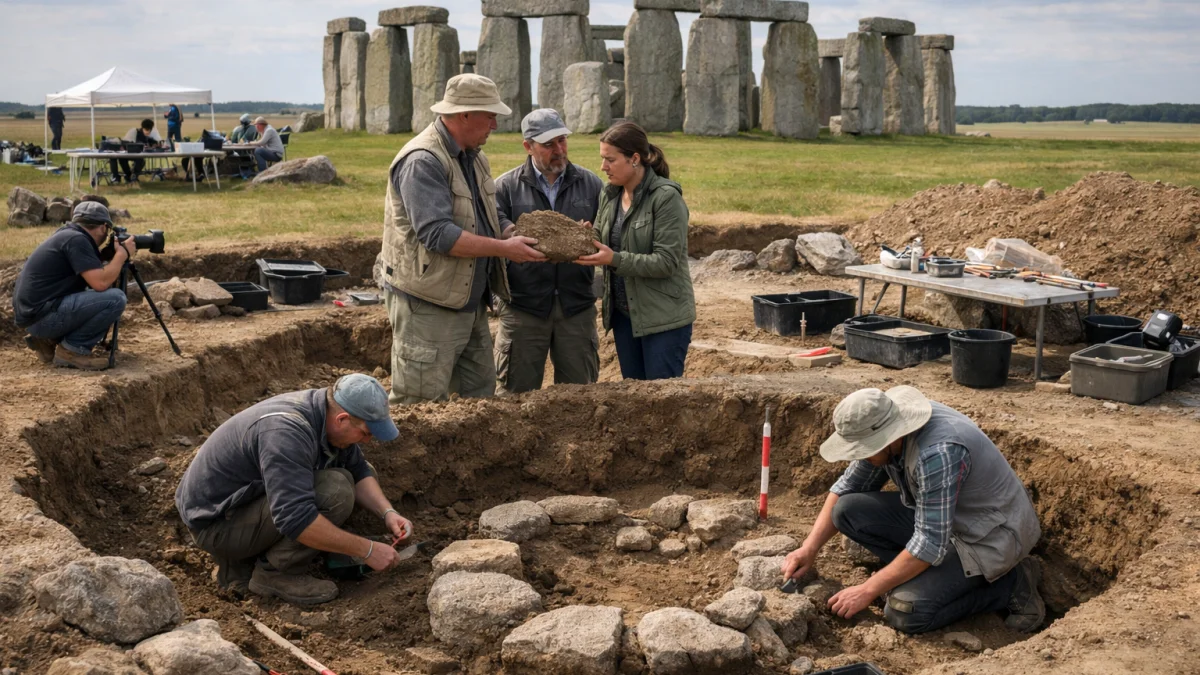
The site was originally identified during archaeological work connected to a British Ministry of Defence housing project. Excavations conducted between 2015 and 2017 uncovered postholes, pottery fragments, animal bones, flint tools and a rare disc-shaped flint knife. Subsequent analysis, including astronomical modeling, confirmed the monument’s alignment with key solar events.
Researchers said the discovery adds to growing evidence that Salisbury Plain served as an important ceremonial and ritual landscape long before Stonehenge was erected. The findings also follow several recent studies examining the origins of Stonehenge’s stones and the broader network of prehistoric monuments in the area. Earlier research published this month provided new evidence regarding the transport of the site’s central Altar Stone from northern Scotland.
English Heritage and other researchers said the new discovery could help improve understanding of how prehistoric communities organized gatherings and marked seasonal changes. Archaeologists emphasized that further study is needed before definitive conclusions can be drawn about the monument’s role or its direct connection to Stonehenge.
As of Thursday, the site had been reburied for preservation, and researchers said additional analysis of artifacts recovered during the excavation remains ongoing. No timetable has been announced for further field investigations.